


Exploring the Art of Flow in Submission Grappling Techniques (Martial Arts Cross Training)

Martial Arts Cross-Training
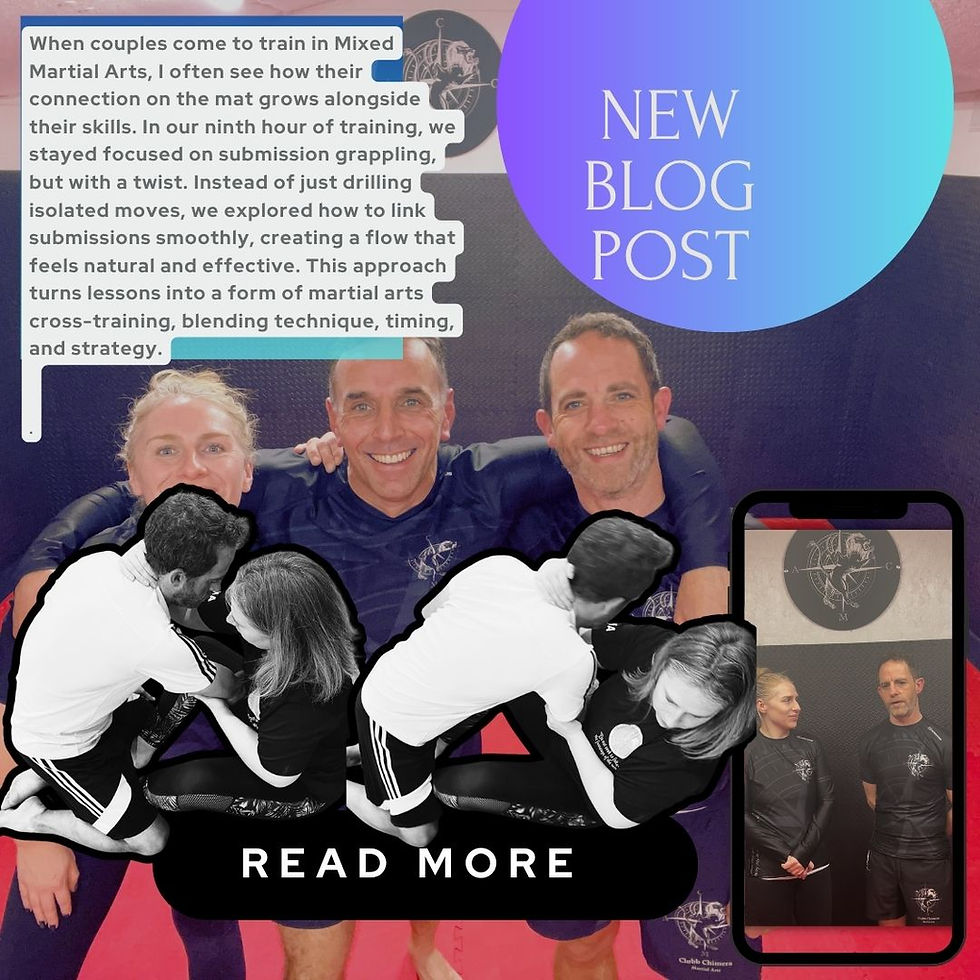
When couples come to train in Mixed Martial Arts, I often see how their connection on the mat grows alongside their skills. In our ninth hour of training, we stayed focused on submission grappling, but with a twist. Instead of just drilling isolated moves, we explored how to link submissions smoothly, creating a flow that feels natural and effective. This approach turns lessons into a form of martial arts cross-training, blending technique, timing, and strategy.
In this post, I want to share how we worked on transitioning between submissions, specifically around necktie attacks, and how this can improve your grappling game while deepening your partnership.
Building on the Necktie Submission
We started by reviewing the caveman necktie submission, a powerful control and choke technique. This move sets up several follow-up options, but many students get stuck trying to finish it without considering what comes next. I encouraged my clients to think beyond the initial attack and look for openings that arise when their partner defends.
For example, when the opponent defends the caveman necktie by turning their head or posturing up, it creates space to switch to other submissions like the Darce choke. Recognizing these moments requires awareness and practice, which is why we spent time drilling transitions between these moves.
Introducing the Darce Choke
The Darce choke is a versatile submission that complements the necktie well. It targets the opponent’s neck and arm, applying pressure that can quickly lead to a tap. We explored different ways to execute the Darce choke, including:
From a sprawl position when the opponent shoots for a takedown
While in side control when the opponent tries to escape
During scramble situations where control is less stable
By practicing these variations, my clients learned to adapt the Darce choke to different scenarios, making it a reliable tool in their arsenal.
Creating Flow Through Constraints-Based Sparring
To help my clients connect these techniques fluidly, we used constraints-based sparring rounds. This means we set specific rules or goals during sparring to focus on certain skills. For example, one round required them to start in a necktie position and try to finish with either the caveman necktie or the Darce choke.
This method encourages creativity and problem-solving under pressure. It also builds muscle memory for transitioning between submissions, which is essential for real-life grappling where situations change rapidly.
Why Martial Arts Cross Training Matters
What we’re doing goes beyond just learning submissions. This kind of training is a form of martial arts cross training, where skills from different grappling styles and scenarios come together. It helps couples develop:
Better timing and anticipation
Increased adaptability during sparring
Stronger communication and trust on the mat
These benefits make the lessons more engaging and practical, especially for couples who want to train together and support each other’s growth.
Practical Tips for Couples Training Submission Flow
If you want to improve your flow between submissions like the necktie and Darce choke, here are some tips based on what I’ve seen work well:
Focus on transitions, not just finishes. Practice moving smoothly from one submission to another instead of forcing a single move.
Use sparring rounds with specific goals. Set challenges like starting from a particular position or using only certain submissions.
Communicate with your partner. Talk about what feels tight or open during drills to understand each other’s reactions better.
Stay relaxed and patient. Flow comes from calm control, not rushing or forcing techniques.
Watch and learn from each other. Couples training together can spot details and adjustments that improve both partners’ skills.
Seeing Progress in Real Time
Watching my clients move from rigid attempts to smooth, connected grappling is rewarding. They gain confidence not only in their technique but also in their ability to read and respond to their partner’s movements. This growth reflects the essence of martial arts cross training: blending skills, adapting quickly, and building a deeper connection.


Comments