


Boxing Cross-Training: Tall Fighter Footwork Lesson Perimeter Anchor to Shrinking Island

Boxing Cross-Training
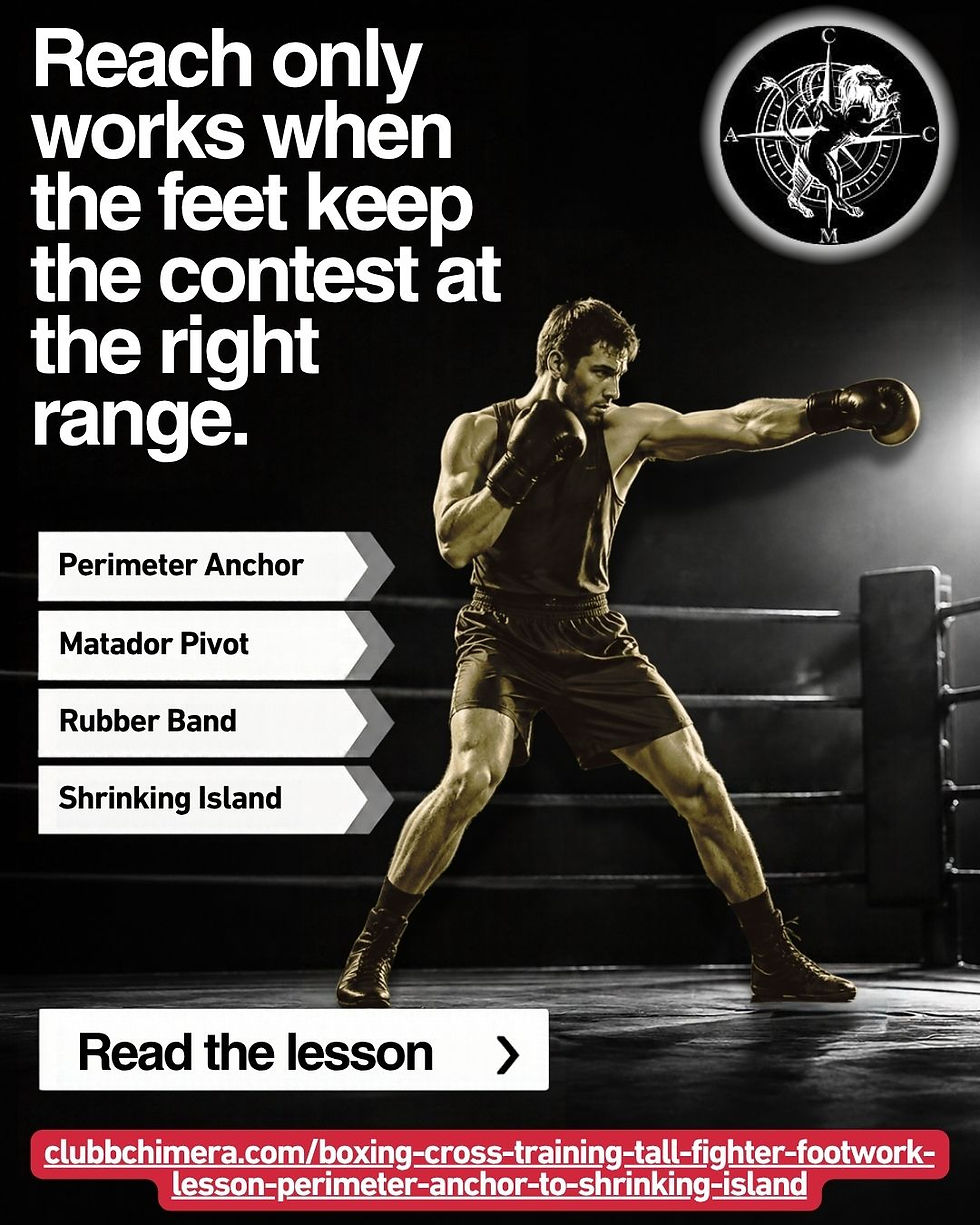
Tall fighters often get told to “use the reach”. That advice is too thin. Reach only works when the feet keep the contest at the right range.
This lesson report covers the second hour of a private course at Clubb Chimera in the Chipping Norton area. The client has a background connected to the Cotswold School of Karate, which gives us a useful base. Karate footwork, distancing, timing and line work all cross over well. The problem is that gloved striking changes the rhythm. The guard, the round shape of punches and the pressure of a shorter fighter all create different demands.
The aim of this hour was clear. Build a taller fighter’s movement game around four constraints:
Stay long without drifting.
Turn an advancing opponent without running.
Break rhythm without giving up stance.
Survive when the space gets smaller.
The session sat well inside a wider Martial arts cross-training approach. We were not trying to replace the client’s karate. We were testing which movement habits transferred, which needed editing, and which broke under pressure.
The warm-up removed the guard to expose the feet
We began with rounds of movement without a raised boxing guard. This was not done for laziness or theatrical flair. It was a deliberate constraint.
When the hands are high, many students hide poor movement behind their gloves. They shell up. They lean. They half-step. They mistake survival for structure. Removing the guard exposes the truth fast.
The rounds focused on:
Lateral movement along the edge of the training area
Shoulder rolls without the security of a full guard
Head movement tied to foot placement
Small exits after each imagined exchange
Recovering stance after slips, rolls and pivots
No guard does not mean no defence. It means the fighter must make the first defence with range, angle and posture.
For a taller fighter, the big temptation is to lean back. That solves one problem and creates three more. The head moves away, but the hips stay behind. The feet get stuck. The chin rises. The shorter fighter now has a path to the body or a chance to crowd the stance.
The first discovery arrived quickly. When the client rolled the shoulder and moved the head without moving the rear foot, everything folded at the waist. When the rear foot moved a few inches with the roll, balance returned.
That became the theme for the hour.
If the head moves and the feet do not support it, the movement becomes a pose.
The warm-up also showed an inherited strength from karate. The client understood distance. They could judge entry well. The missing piece was continued movement after the first beat. In point sparring, the exchange often resets after a clean score. In boxing-style training, the exchange keeps talking. The second and third steps matter.
The Perimeter Anchor taught range without retreat
The first main round was called The Perimeter Anchor.
The task was simple. The taller fighter had to maintain optimal distance while moving around the outside of a marked area. The shorter fighter’s job was to close distance behind a light threat. The taller fighter could not sprint away. They had to stay near the perimeter, keep form and deny easy entry.
This round addressed a common tall fighter problem. Tall fighters often back up in straight lines because it feels safe. Their reach buys time. Their eyes see the threat coming. Yet a straight retreat leads to the ropes, the wall, or a square stance. Once the shorter fighter gets chest-to-chest, height can become a liability.
The anchor was the lead foot. It had to mark the outside lane without becoming nailed to the floor. The client had to feel the perimeter as a guide, not a prison.
Key problems appeared within the first minute:
The lead foot crossed over when moving left.
The rear foot lagged when moving right.
The stance lengthened during retreat.
The head drifted behind the rear heel.
The jab hand wanted to solve every range problem.
The task constraints fixed the lesson better than a lecture could. The client had limited space, a moving threat, and instructions not to abandon the perimeter. That forced better solutions.
The main affordance discovery was the half-step reset. A tall fighter does not always need a full retreat. Often, a half-step with the rear foot restores long range. Then the lead foot can pivot or slide to keep the line.
The second discovery was that the jab begins in the feet. The arm can touch first, but the feet decide whether the punch has meaning. When the client stepped out after touching with the lead hand, the range stayed clean. When they admired the touch, the shorter fighter entered.
We used a simple rule.
Touch, move, face.
Touch with the lead hand. Move the feet. Face the opponent again before they square you up.
The round ended with better perimeter discipline. The client stopped treating the edge as a place of doom. It became a tool for measuring distance.
The Matador Pivot used angles against pressure
The second round was The Matador Pivot.
The image helped. A matador does not win by running backwards from the charge. The body turns, the line changes, and the attacker passes into empty space. We kept the romantic image, but stripped away any nonsense. This was footwork under pressure.
The shorter fighter pushed forward from mid-range. The taller fighter had to redirect with pivots, shoulder turns and short angle changes. The taller fighter could not take more than two backward steps in a row.
This constraint mattered. Without it, a tall fighter with decent legs will often choose retreat as the first answer. Retreat is useful, but overuse makes the opponent braver. The shorter fighter starts to read the pattern.
The jab and lead shoulder became the steering tools. The client used a light frame, not a stiff shove. A stiff arm can get collapsed. A light post gives information. It says where the opponent is, how fast they are entering, and which side is open.
Three pivot types emerged:
Lead foot pivot after a jab touch
Rear foot step-around after a shoulder roll
Small L-step when the shorter fighter cut the line
The first key problem was over-rotation. The client turned too far and gave the back line. This often happens with students who enjoy the feeling of a clean pivot. The turn becomes the goal. It should not. The goal is to face the opponent from a safer angle.
The second problem was the head staying central. If the head remains on the line while the feet pivot, the opponent can still punch through the turn. We linked head movement to the pivot. Slip outside, pivot, recover stance.
The affordance discovery was the outside shoulder. When the shorter fighter entered low and forward, the taller fighter found that the lead shoulder could guide the turn. Not by pushing hard. By touching, rolling and letting the feet carry the body off line.
This is where the client’s karate background helped. The idea of an angle was familiar. What changed was the timing. The angle had to happen during the opponent’s advance, not after a tidy reset.
The coaching cue became:
Do not escape the person. Escape the line.
Against shorter opponents, this matters. A shorter fighter often wants the tall person moving backwards with the head high. The pivot denies that story. It makes the shorter fighter turn before they can work.
The Rubber Band broke predictable rhythm
The third round was The Rubber Band.
The aim was to stretch and contract the distance without falling into a pattern. The taller fighter had to move in and out, sometimes claiming space, sometimes giving it, sometimes pausing just long enough to make the shorter fighter misread the timing.
This round attacked rhythm.
Many tall fighters develop a steady bounce at long range. It looks athletic. It can also become a metronome for the opponent. A shorter fighter times the bounce, steps in on the lift, and arrives under the jab.
The client’s natural rhythm was clean but too honest. The feet gave early warnings. The lead shoulder twitched before the step. The back foot loaded before the exit. A good pressure fighter reads those signs.
The constraints were:
Change tempo every three to five movements
Do not bounce on every beat
Enter with the feet before the hands at least once per exchange
Exit at an angle after any long step
Keep the stance under the hips
The key problem was stance stretching. When the client pulled away fast, the feet split wide. This created a long target and delayed the next movement. A tall fighter cannot afford that. Long legs need recovery time. The wider the stance, the more time gets stolen.
The affordance discovery was the pause.
Not a dead pause. A loaded pause.
The client found that holding position for a fraction of a second after a feint made the shorter fighter reveal their entry. That gave the taller fighter a cleaner exit or a chance to touch and turn. The pause worked because it was backed by balance. A pause with weight on the heels would fail.
We then layered in shoulder rolls and head movement. The client rolled under an imagined right hand, stepped out, then bounced back into long range. The movement resembled a rubber band. Stretch, contract, stretch again. No fixed beat.
A useful coaching test came from the shorter fighter’s feet. If the pressure fighter could step in smoothly, the rhythm was too readable. If their feet hesitated or crossed, the rhythm had been disturbed.
The best sequence of the round was not flashy. The client feinted with the lead shoulder, took a short step in, touched the jab, paused, then pivoted out as the shorter fighter overcommitted. That is efficient work. No wasted drama.
The Shrinking Island tested movement under confinement
The final main round was The Shrinking Island.
We reduced the available space. Then we reduced it again. The taller fighter had to maintain structure while under pressure from a shorter opponent. The aim was not to win a fantasy exchange. The aim was to make good decisions when the usual long-range tools were restricted.
This is where tall fighters often feel the lesson turn against them. Long levers need room. The jab needs space. Long exits need clear lanes. When the island shrinks, panic encourages poor habits:
Standing upright
Reaching down with punches
Leaning on the opponent
Turning the back during escape
Trying to jump out of trouble
The task constraints were unforgiving:
Stay inside the marked area
Use no more than one long retreat per exchange
Turn after contact
Keep the head off the centre line
Do not clinch unless balance has already been protected
The first problem was emotional as much as technical. The client felt the pressure rise when space disappeared. That is useful information. Private training should bring out that information in a controlled way. It is better to meet it in a lesson than discover it during hard sparring.
The second problem was posture. The client wanted to get small by bending at the waist. That gave away the height advantage without gaining real safety. We changed the instruction. Do not get lower by folding. Get safer by moving the feet and changing the head position.
The affordance discovery was the short pivot after contact. When the shorter fighter entered, the client touched with forearm or glove, shifted the lead foot and turned. The movement did not need to be large. A quarter turn was enough to stop the pressure line.
Another discovery was the body target. Taller fighters often head-hunt because the head is easy to see from above. Against a shorter fighter, the body can be the better steering wheel. A touch to the chest line or body line can hold range while the feet escape. This was kept light and technical, but the lesson was clear.
The round also showed where training has to go next. The taller fighter needs close-range answers that do not betray the long-range game. That means inside frames, short upper-body movement, compact punches and better comfort in the pocket. The feet still lead the lesson. Even in tight space, movement solves more problems than panic.
What the second hour proved
This hour gave us a clearer profile of the client as a taller fighter.
Strengths:
Good sense of distance from karate training
Willingness to work under constraints
Fast understanding of angles
Good composure when feedback was specific
Needs:
Less straight-line retreat
Better stance recovery after long steps
More rhythm changes
More comfort when space is denied
Stronger link between head movement and foot placement
The four rounds created a useful progression. The Perimeter Anchor built distance. The Matador Pivot redirected pressure. The Rubber Band disturbed timing. The Shrinking Island tested the same ideas under stress.
That order matters. If we began with confinement, the client would have survived rather than learned. If we only trained open-space movement, the lesson would have flattered the tall fighter. Good private coaching needs both.
For anyone interested in private martial arts training in the Cotswolds, this is the kind of work that benefits from individual attention. Height, background, confidence, habits and goals all change the lesson. To explore that route, see private martial arts and fitness training at Clubb Chimera.
FAQ
Why is footwork harder for taller fighters?
Taller fighters often have longer steps and a higher centre of balance. That can help at range, but it can slow recovery after big movements. Shorter opponents can exploit this by closing distance fast and forcing rushed decisions.
Should a taller fighter always stay on the outside?
No. Outside range is a major advantage, but staying there all the time becomes predictable. A taller fighter also needs pivots, short exits, body touches and close-range survival skills.
Why train warm-up rounds without a guard?
Removing the guard reveals problems in balance, footwork and head movement. It stops the gloves from hiding poor positioning. The guard returns later, but the body learns to defend with movement first.
Does karate experience help with this type of training?
Yes, especially with distance, timing and angles. The main adjustment is continuity. In boxing-style rounds, the exchange often keeps going after the first action, so the feet must reset and move again.
What is the main takeaway from this lesson?
A tall fighter’s reach only works when the feet protect it. Range, pivots, rhythm changes and pressure management need to be trained together. The lesson is not to move more. It is to move with better purpose.


Comments