


Child Self-Protection Cover, Trust and Tactical Skills for Kids

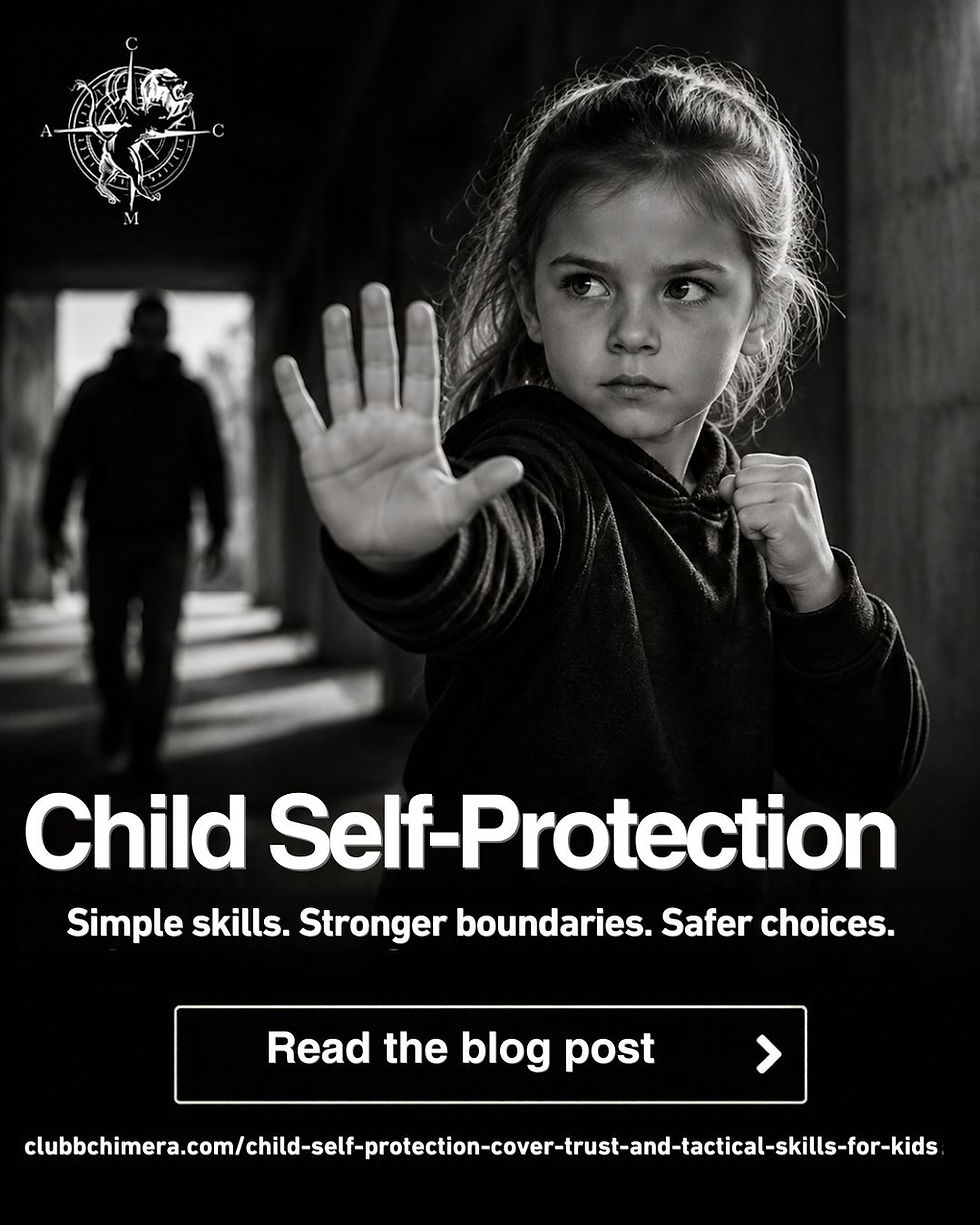
Child Self-Protection
A child does not need a long list of moves. They need simple actions they can use under pressure.
Lesson five of a child self-protection course brings together movement, striking, recovery, awareness, and trust. The session revises key physical skills from earlier lessons, then adds a new defensive posture called the cover. It also develops a vital soft skill, knowing who belongs in a child’s circle of trust and what healthy boundaries look like.
This lesson matters because real safety is not just about hitting pads. It is about noticing risk early, setting boundaries, recovering when things go wrong, and getting away.
Lesson five builds skills children can use under stress
Good self-protection training for children should be simple, repeatable, and age-appropriate. The goal is not to turn children into fighters. The goal is to help them recognise trouble, use clear words, move away, and protect themselves if escape is blocked.
Children's self-protection works best when physical skills and decision-making are taught together. A child who can move well but cannot spot warning signs is missing a key part of safety. A child who understands danger but freezes when grabbed also needs practical training.
Lesson five keeps both sides connected.
The hard skills revised in this lesson include:
Skill | Purpose | Coaching point |
Four posture tactical get-ups | Stand safely from different positions | Keep distance and protect the head |
Fence and pre-emptive striking | Create a boundary and act before being overwhelmed | Use only when there is a clear threat and escape is needed |
Incidental combinations | Build natural follow-up actions | Do not rely on memorised patterns |
Removing obstructions | Clear anything blocking escape | Move the barrier, then move the body |
Striking from the ground and off the back | Create space when knocked down | Strike to get up, not to stay on the ground |
A tactical get-up means standing in a way that keeps the child safer. They do not turn their back. They do not put both hands on the floor and lose sight of the person in front of them. They protect their head, keep their eyes up, and move away as soon as they have space.
The four posture revision gives children practice from common positions. These may include being seated, kneeling, side-on to the floor, or on their back. The exact posture matters less than the principle: recover position, create space, stand, and leave.
Repetition matters here. Under pressure, people tend to lose fine control. Simple whole-body actions are easier to remember than complex sequences. That is why the get-ups are drilled from different angles, with clear instruction and safe speed.
The fence teaches space, voice, and action
The fence is one of the most useful positions in child self-protection. It looks like a non-aggressive hand position, usually with the hands open and held between the child and the other person.
It has three jobs.
It creates a physical boundary. It gives the child a protected position if someone moves in. It also supports clear verbal commands, such as:
“Stop.”
“Move back.”
“Leave me alone.”
“I don’t want you near me.”
The fence should not look like a fighting stance. That matters. A child may need to use it in school, at a park, outside a shop, or near a bus stop. Open hands are easier to explain than clenched fists. They also keep the child ready to push, shield, strike, or run if the situation becomes dangerous.
Pre-emptive striking must be taught with care
Pre-emptive striking means acting before the other person lands an attack. For children, this must be taught with clear limits.
It is not about starting fights. It is not about punishing someone. It is not about winning an argument.
It is for a situation where a threat is clear, space is closing, escape is blocked or unsafe, and the child needs to create a chance to get away.
In UK self-defence law, the use of force must be reasonable in the circumstances as the person believed them to be. Children do not need a legal lecture, but they do need simple rules:
Use your voice first if you can.
Move away if you can.
Tell a safe adult as soon as possible.
Use physical action to escape danger, not to carry on the conflict.
In training, pre-emptive actions are practised on pads. The child learns to use a strong, simple strike from the fence, then move. The message is clear: hit the pad, make space, get out.
Incidental combinations stop children freezing after one action
Many people freeze after their first movement. They push once, then stop. They strike once, then admire the result. That pause can be costly.
Incidental combinations teach children to link actions naturally. If one action does not create enough space, the next one follows. A palm strike may lead into a shove. A shove may lead into a tactical get-up. A strike from the ground may lead into turning to the side, posting a hand, standing, and running.
These combinations are not long routines. They are short problem-solving chains.
For example:
Hands up in fence.
Clear the reaching hand.
Strike the pad.
Move past the obstruction.
Run to a safe adult or safe place.
This helps children understand that self-protection is not one magic move. It is a series of decisions made quickly.
The cover helps a child recover and regain initiative
Lesson five introduces the cover as a defensive posture. This is one of the most important recovery tools in the course.
The cover protects the head and gives the child a way to cope when something has gone wrong. That may mean they have been surprised, pushed, crowded, or hit. The cover is not a place to hide. It is a short-term tactic used to recover.
A good cover should help the child:
protect the head and neck,
keep balance,
breathe,
keep some view of what is happening,
move to a better position,
regain initiative.
Regaining initiative means taking back the ability to act. A frightened child may go still. The cover gives them a structure. Hands come up. Chin lowers. Elbows come in. Feet move. The child gets through the bad moment and does something useful next.
That next action may be:
moving behind a barrier,
calling for help,
pushing away,
striking a pad to create space,
using a tactical get-up,
escaping to a safer area.
The cover also links well with ground skills. If a child falls or is knocked down, they may need to cover before they can strike from the ground or stand. This prevents panic. It gives them a first step.
Striking from ground positions has one main goal
Ground striking in child self-protection should be direct and limited. The goal is to make enough space to get up.
A child on the floor is in a dangerous position. They may be unable to run. They may be near hard surfaces. They may have limited vision. Training should not encourage them to stay there longer than needed.
Striking off the back can include kicks to a pad, heel pushes, or hand strikes from a protected position. The child learns to keep the other person away from their head and body. They then use a tactical get-up as soon as there is space.
This is where earlier lesson material becomes useful. The child covers, strikes from the ground, clears the obstruction, and gets up. One skill feeds the next.
Removing obstructions teaches children to solve the real problem
An obstruction is anything that blocks escape. It could be a person in the way. It could be a hand on clothing. It could be a bag strap, a chair, a doorway, or the child’s own position on the floor.
Children often try to pull straight back when grabbed or crowded. That can fail. Lesson five helps them look for the barrier and remove it.
The coaching is simple:
Find what is stopping you.
Clear it.
Move your feet.
Get to safety.
This is useful because it changes the child’s focus. Instead of thinking, “I am stuck,” they learn to ask, “What do I need to move first?”
Private lessons can be useful for this part of training, because children vary in confidence, size, coordination, and past experience. Some need more time with voice work. Others need more help with balance, falling safely, or getting up from the floor.
Awareness and trust are part of the lesson
The soft skills in lesson five revise situational awareness and pre-incident indicators.
Situational awareness means paying attention to what is happening nearby without becoming fearful. Children can learn this through simple games and questions.
Examples include:
Who is near you?
Where are the exits?
Is someone following too close?
Has the mood changed?
Where is the nearest safe adult?
What would you do if you felt unsure?
Pre-incident indicators are warning signs that something may happen. These signs do not prove danger, but they deserve attention.
Common examples include:
someone ignoring “no”,
someone moving closer after being told to stop,
someone blocking the path,
someone trying to separate a child from others,
someone using secrecy to create pressure,
sudden anger, staring, or clenched fists,
a person asking for help that should come from an adult.
Children should not be taught to fear everyone. They should be taught to notice behaviour. Behaviour gives better information than appearance.
A calm person can be unsafe. A scruffy person can be harmless. A familiar person can still cross a boundary. That point leads into the new soft skill for lesson five.
The circle of trust teaches boundaries without fear
The circle of trust helps children understand who they trust, how much they trust them, and what to do when someone crosses a boundary.
A simple model uses circles.
At the centre are the safest people in the child’s life. These may include parents, carers, and trusted family members. The next circle may include teachers, coaches, relatives, or family friends. Further out are people the child knows a little. Outside the circle are strangers or people who have not earned trust.
The key lesson is this: trust is not all or nothing.
A child may trust a swimming teacher to teach swimming, but that does not mean the teacher can ask for secrets. A child may like an older child at school, but that does not mean they must follow them somewhere alone. A relative may be loved, but the child still has the right to say no to unwanted touch.
Healthy trust has boundaries.
Children need clear rules they can remember:
Safe adults do not ask children to keep unsafe secrets.
Safe adults listen when a child says no to unwanted contact.
Safe adults do not use gifts, status, or guilt to force closeness.
Safe adults do not ask children to break family safety rules.
A child can ask for help from more than one trusted adult.
This is not about making children suspicious. It is about giving them language.
A child who can say, “That is outside my boundary,” has a tool. A child who knows they can tell more than one safe adult has a support system. A child who understands that trust can change is better prepared to respond when someone behaves badly.
This part of the lesson should be handled calmly. No shock tactics. No fear-based examples. Children learn better when the message is clear, practical, and steady.
FAQ
Is lesson five suitable for children with no martial arts experience?
Yes, if the class is taught at the right pace. The movements should be simple, safe, and built around escape rather than fighting. A good instructor will adjust the drills to the child’s age and confidence.
Will pre-emptive striking make a child more aggressive?
Not when taught properly. The lesson should frame striking as a last resort to create space and escape. Children should also practise voice commands, moving away, and telling a safe adult.
What is the difference between the fence and the cover?
The fence is used before contact or at the start of a threat. It creates space and sets a boundary. The cover is used when the child needs to recover, protect the head, and regain the ability to act.
How can parents support the circle of trust at home?
Use simple questions. Ask who your child would go to if they felt unsafe. Talk about safe and unsafe secrets. Make it clear that they can tell you about uncomfortable behaviour, even if the person involved is known to the family.
Are these lessons available near Chipping Norton?
Yes, training is available in the Chipping Norton area. Sessions can focus on confidence, awareness, boundaries, and practical self-protection skills for children.
Lesson five ties the course together. Children revise how to get up, use the fence, strike to escape, clear obstructions, and recover with the cover. They also sharpen their awareness and learn how trust should work in real life.
For course details and booking information, visit the children’s self-protection lesson page.


Comments