


Integrating Muay Thai Techniques into Karate Bunkai for Effective Sparring (Muay Thai Personal Training)

Muay Thai Personal Training
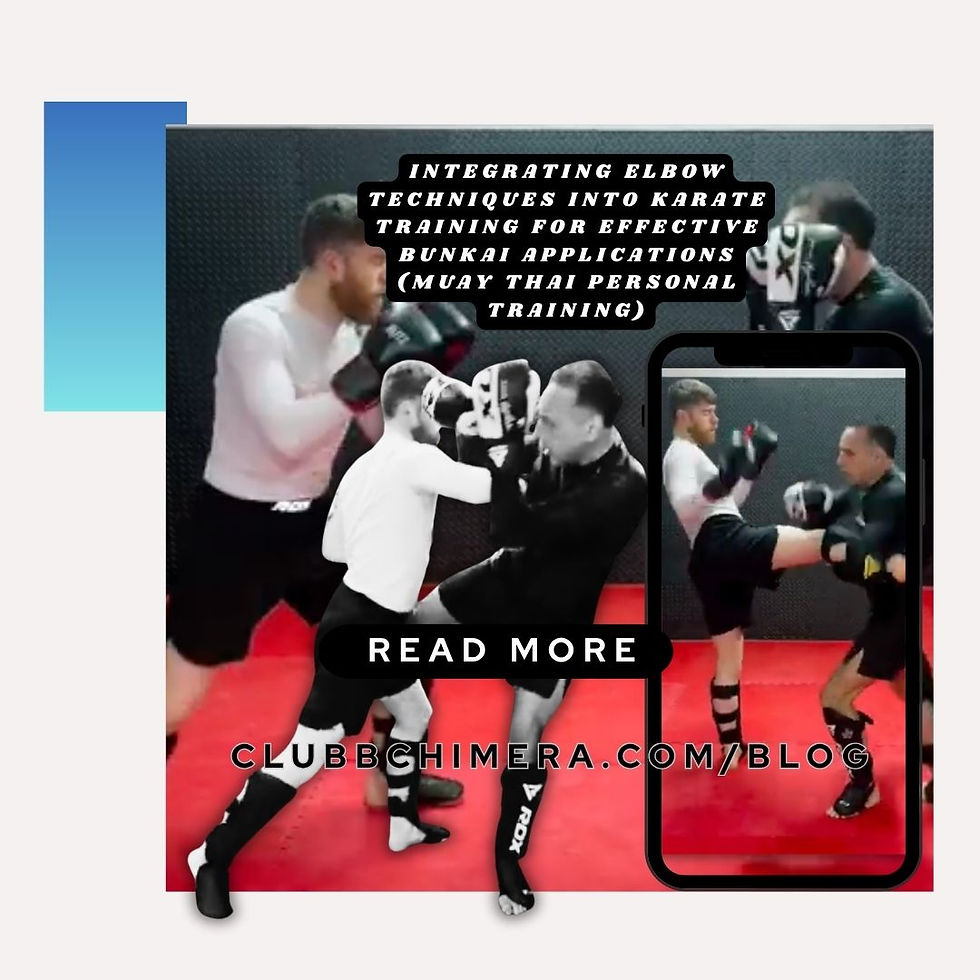
When teaching martial arts, one challenge is helping students apply traditional kata techniques under real sparring pressure. Over the past several sessions with my client from Cotswold Karate School, I have introduced elements of Muay Thai personal training to enhance their Karate bunkai. This approach brings fresh perspectives and practical tools to bridge the gap between form and function. In this post, I share how we combined Muay Thai techniques with Karate principles, focusing on sparring drills that build confidence and adaptability.

Building Foundations with Muay Thai Techniques
Our journey began by exploring key Muay Thai strikes that complement Karate’s movement and strategy. We started with low kicks, adopting a Dutch Kickboxing style to emphasize precision and timing. Low kicks target the opponent’s legs, disrupting balance and mobility, which aligns well with Karate’s focus on controlling distance and movement.
Next, we introduced knee strikes, a powerful close-range weapon in Muay Thai. These strikes add a new dimension to the client’s arsenal, especially useful in clinch situations where Karate’s linear strikes might be less effective. Finally, we worked on elbow strikes, which offer sharp, close-quarter attacks that can break through an opponent’s guard.
Each technique was drilled separately to build muscle memory and confidence. This step-by-step approach ensures the client understands the mechanics before combining them in sparring.
Structured Sparring Rounds to Integrate Skills
To bring these techniques together, I designed specific sparring rounds that isolate and then combine different elements. This structure helps the client focus on one aspect at a time, gradually increasing complexity:
Boxing only: Focus on punches to sharpen hand speed and accuracy.
Teeps only: Practice front push kicks to control distance.
Straight punches and teeps only: Combine hand strikes with teeps for a balanced attack and defense.
Kickboxing with low kicks and all punches: Add leg kicks to the punch combinations.
Kickboxing with all kicks and punches: Use the full range of Muay Thai strikes.
Clinch with knees, elbows, and sweeps: Develop close-range control and counterattacks.
Full Muay Thai sparring: Apply all techniques fluidly under pressure.
This progression allows the client to experience each technique’s role in a controlled environment before moving to full sparring. It also highlights how Muay Thai’s practical striking methods can enhance Karate’s traditional forms.
Applying Muay Thai to Karate Bunkai
The ultimate goal is to translate these Muay Thai techniques back into Karate’s kata-based sparring and bunkai. Kata movements often contain hidden applications for strikes, blocks, and counters, but they can feel rigid without real-time pressure.
For example, the kata Nahanchi includes strong stances and linear strikes that can be adapted with Muay Thai’s low kicks and clinch work. By practicing sparring rounds that emphasize these elements, the client learns to apply kata techniques dynamically. The clinch drills with knees and elbows teach how to maintain control and exploit openings, which is often missing in traditional Karate sparring.
This fusion encourages students to think beyond the kata’s choreography and develop practical responses to an opponent’s actions. It also builds confidence in using a wider range of techniques, making their Karate more versatile and effective.
Practical Tips for Martial Arts Teachers
If you want to incorporate Muay Thai personal training into your Karate classes, consider these steps:
Start with basics: Introduce low kicks, knees, and elbows separately before combining them.
Use focused sparring rounds: Design drills that isolate specific techniques to build skill and confidence.
Encourage adaptability: Help students see how kata movements can be modified for real sparring.
Emphasize control and safety: Teach proper technique to avoid injury, especially with elbows and knees.
Build gradually: Increase sparring intensity as students become comfortable with new techniques.
By blending Muay Thai’s practical striking with Karate’s structured forms, you can offer students a richer training experience that prepares them for real combat situations.
What’s Next in Our Training Journey
In the next lesson, we will focus on adapting moves from the Nahanchi kata for sparring under pressure. This will involve breaking down kata sequences and testing their effectiveness in live drills. The goal is to create a seamless connection between traditional Karate bunkai and the dynamic techniques learned through Muay Thai personal training.
If you are a martial arts teacher looking to expand your curriculum, stay tuned for more insights from my work with Cotswold Karate School. Together, we can help students unlock the full potential of their martial arts practice.
Integrating Muay Thai techniques into Karate bunkai offers a practical way to enhance sparring skills and deepen understanding of kata applications. By structuring training with focused sparring rounds and emphasizing real-world effectiveness, martial arts teachers can help students become more adaptable and confident fighters. The fusion of these two disciplines opens new doors for growth and mastery in martial arts education.

Comments