


Transitioning from Boxing to Kickboxing Personal Training: Enhancing Technique with Constraints-led Games

Kickboxing Personal Training
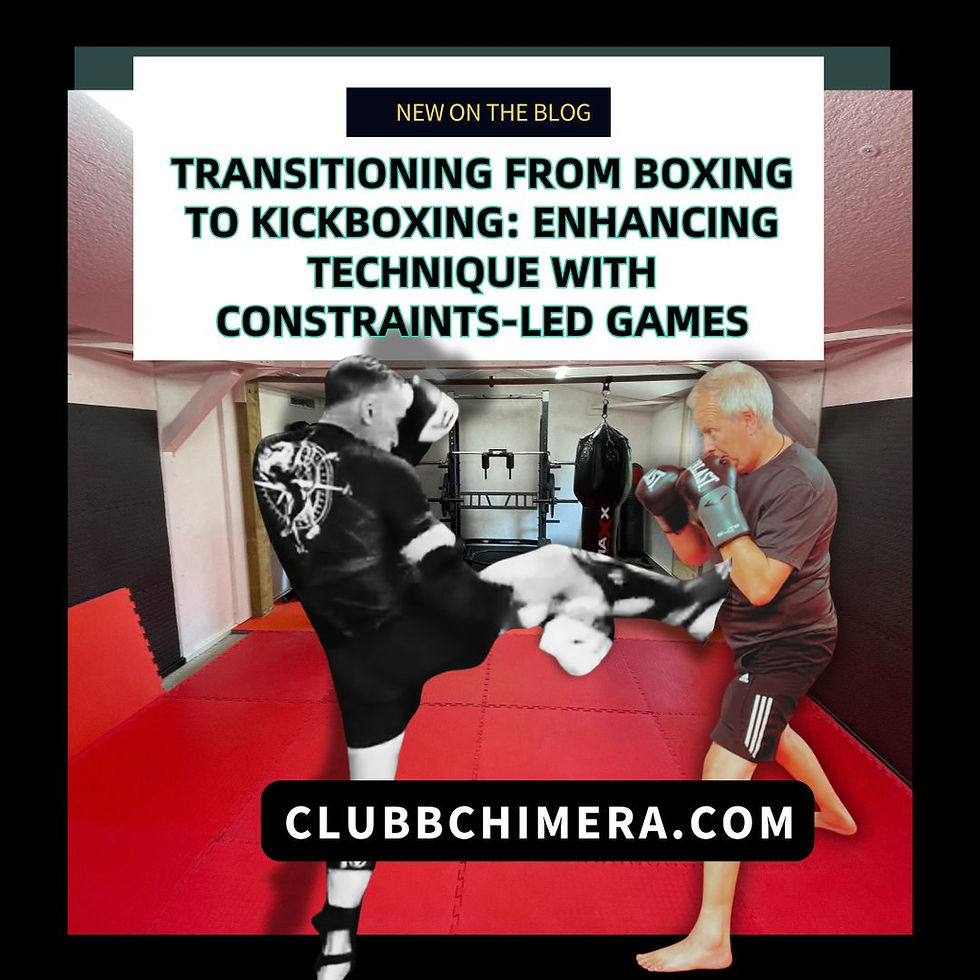
Starting a new martial arts discipline can be both exciting and challenging, especially when moving from a familiar sport like boxing to kickboxing. My senior client recently made this transition after a year focused solely on boxing. This change aims to build a solid foundation for an upcoming Muay Thai course. In our latest session, we concentrated on mastering the teep, a fundamental kickboxing technique, using constraints-led games to sharpen precision and timing. This post shares insights from that experience and explains how this approach benefits senior clients in kickboxing personal training.
Why Transitioning from Boxing to Kickboxing Matters
Boxing and kickboxing share some similarities, but they also have distinct differences that require adjustments in stance, movement, and technique. Boxing emphasizes punches, footwork, and head movement, while kickboxing adds kicks, knees, and a wider range of striking angles.
For seniors, this transition offers several benefits:
Improved balance and coordination: Incorporating kicks challenges stability and body control.
Enhanced cardiovascular fitness: Kickboxing involves more muscle groups, increasing aerobic capacity.
Mental engagement: New techniques stimulate cognitive function and focus.
By moving gradually from boxing to kickboxing, clients can build confidence and avoid injury while expanding their skill set.
Using Constraints-led Games to Teach the Teep
The teep, also known as the push kick, is a versatile tool in kickboxing. It can keep opponents at bay, disrupt their rhythm, or set up other strikes. Teaching the teep effectively requires more than just drilling the kick repeatedly. That’s where constraints-led games come in.
What Are Constraints-led Games?
Constraints-led games are training exercises designed with specific rules or limitations that encourage learners to explore and discover effective movement solutions. Instead of simply copying a technique, clients adapt to challenges that mimic real fight scenarios.
How We Applied This to the Teep
In our session, I introduced a series of games with these constraints:
Target zones: The client had to land the teep on specific areas such as the midsection or thigh, improving accuracy.
Timing windows: The teep had to be executed within a short time frame after a jab, encouraging quick decision-making.
Feint combinations: The client practiced using jabs and teeps interchangeably as feints to confuse an imaginary opponent.
These constraints helped my client focus on the teep’s role as both an attacking and defensive tool. For example, pairing a jab with a teep forces the opponent to guess which strike is coming, creating openings.
Benefits of This Approach for Seniors
Reduced injury risk: Games keep training dynamic but controlled.
Increased engagement: The playful nature of games maintains motivation.
Better skill retention: Learning through problem-solving improves memory.
Adaptability: Clients learn to adjust techniques based on context, a key skill in real situations.
Pairing the Teep with Boxing Techniques
One challenge for clients transitioning from boxing to kickboxing is integrating kicks with familiar punches. The teep works well with jabs because both can be used to control distance and set up combinations.
In practice, we worked on:
Throwing a jab to gauge distance and distract.
Following immediately with a teep to push the opponent back.
Using either strike as a feint to create openings for the other.
This combination builds fluidity and helps clients think strategically rather than mechanically.
Preparing for Low Round Kicks
Our next session will focus on low round kicks, which target the opponent’s legs to reduce mobility and power. These kicks require good hip rotation and balance, so mastering the teep first lays a strong foundation.
For seniors, low round kicks can improve:
Leg strength and flexibility
Balance and coordination
Defensive awareness
We will continue using constraints-led games to make learning these kicks safe and effective.
Why Kickboxing Personal Training Works for Seniors
Kickboxing personal training offers tailored instruction that respects each client’s pace and physical condition. For seniors, this means:
Customised drills that build on existing skills.
Focus on technique to prevent injury.
Gradual progression to more complex movements.
Encouragement and motivation in a supportive environment.
By combining boxing experience with new kickboxing skills, clients gain confidence and enjoy a richer martial arts journey.



Comments