


Mastering Transitions: The Heat-Seeking Kimura in Submission Grappling Personal Training
- jamie03066
- Jun 15
- 3 min read
Submission Grappling Personal Training
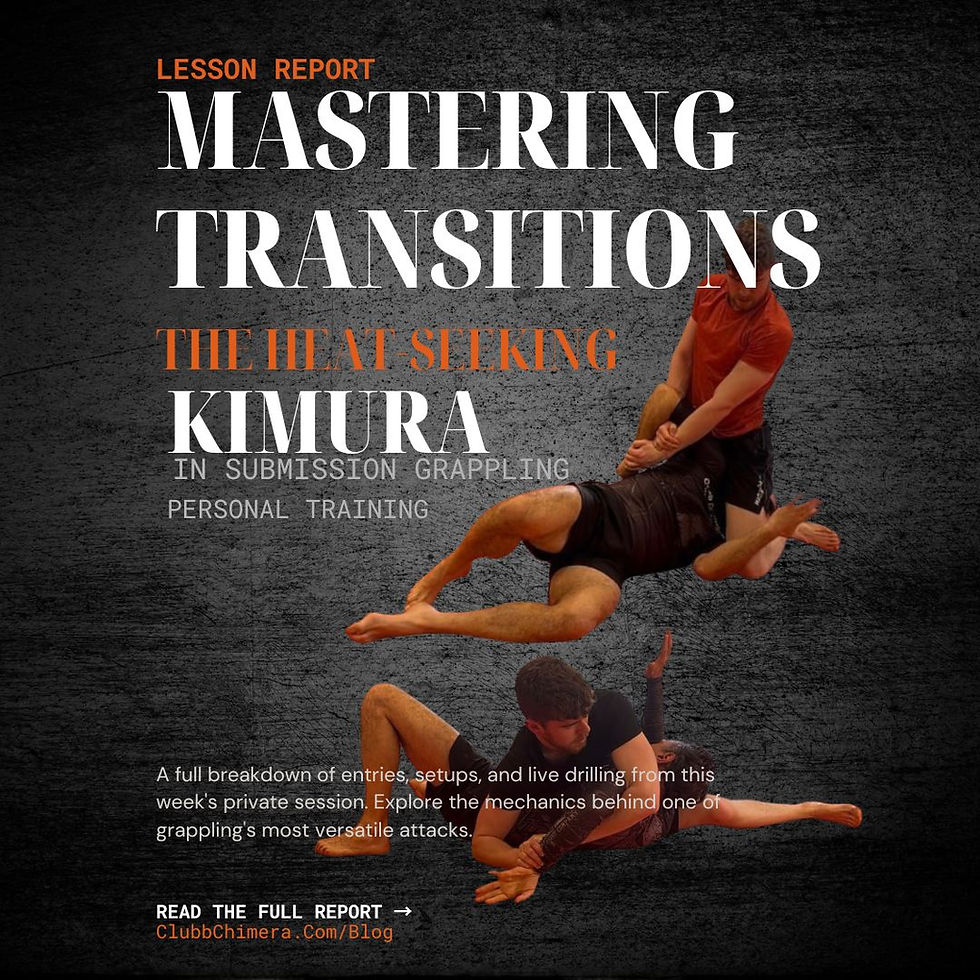
Submission grappling personal training demands more than just knowing individual techniques. Success often depends on smooth transitions and the ability to chain attacks fluidly. One drill that highlights this approach is the "heat-seeking kimura," a sequence that links multiple arm locks through positional changes. This post explores how this drill fits into training from the north south position, its practical applications, and how it builds a stronger grappling game.
Understanding the North South Position and Its Challenges
The north south position places the top grappler facing the opponent’s head, controlling their upper body with chest pressure. While it offers control, submissions from here can be tricky. The north south choke is a known technique but has a lower success rate compared to other submissions. Still, it’s important to learn for its situational value.
More effective from this position are arm locks like the kimura. The kimura lock attacks the opponent’s shoulder and elbow, creating leverage to force a tap or improve position. Training this lock from north south helps develop control and submission skills in a less common but valuable spot.
The Heat-Seeking Kimura Drill Explained
The heat-seeking kimura is a flow drill that combines several arm locks while transitioning through dominant pins. It starts with an Americana from side control, moves into scarf-hold, then transitions into a kimura as you shift into north south. The sequence finishes with an arm-bar setup, all targeting the same arm.
This drill teaches:
Smooth transitions between positions without losing control
Constant hip pressure to maintain dominance
Targeting one arm consistently to create submission opportunities
Flowing attacks that keep the opponent reacting and off balance
By drilling this sequence repeatedly, grapplers develop muscle memory for chaining attacks and maintaining pressure, which is crucial during live sparring.
Key Elements for Effective Execution
To get the most from the heat-seeking kimura drill, focus on these elements:
Hip pressure: Keep your hips heavy and close to the opponent’s body to limit their movement. This pressure makes it harder for them to escape or counter.
Grip control: Secure strong grips on the opponent’s arm throughout the transitions. Losing grip control often means losing the submission opportunity.
Body positioning: Adjust your body as you move from side control to scarf-hold and then north south. Each position requires subtle shifts to maintain control and prepare for the next attack.
Timing: The flow depends on smooth timing. Avoid rushing; instead, feel the opponent’s reactions and move when openings appear.
Practicing these details helps build a more effective and fluid grappling style.
Training Live Sparring from Specific Positions
After drilling the heat-seeking kimura, live sparring from side control, scarf-hold, and north south positions reinforces the concepts. Sparring with a focus on smooth transitions and constant hip pressure allows grapplers to test their skills under resistance.
During sparring, the goal is not just to land submissions but to maintain control and flow between positions. This approach builds confidence and adaptability, essential traits for real competition or self-defense scenarios.
Preparing for the Next Step: Knee-on-Belly Position
The next phase of training will cover the knee-on-belly position. This position offers dynamic control and opens up a different set of submissions and transitions. Mastering the heat-seeking kimura and north south control lays a solid foundation for moving into knee-on-belly techniques.
Practical Tips for Incorporating the Heat-Seeking Kimura into Your Training
Start slow: Drill the sequence slowly to understand each transition and grip.
Use a training partner: Feedback helps identify weak points in control or timing.
Add resistance gradually: Begin with cooperative drilling, then increase resistance during sparring.
Focus on one arm: Targeting the same arm throughout the sequence simplifies the attack and increases success chances.
Record your sessions: Watching footage can reveal areas for improvement in positioning or pressure.
Final Thoughts on Building a Strong Grappling Game
The heat-seeking kimura drill is more than a submission sequence; it’s a tool for developing flow, control, and pressure in grappling. By linking multiple arm locks through smooth transitions, grapplers learn to maintain dominance and create constant threats.
Training this drill alongside live sparring from the north south position builds confidence and skill. As you progress, adding new positions like knee-on-belly will expand your arsenal and improve your overall grappling game.


Comments