


Sixth Lesson MMA Lab Jab to Scramble Resets Through Constraints Led Games

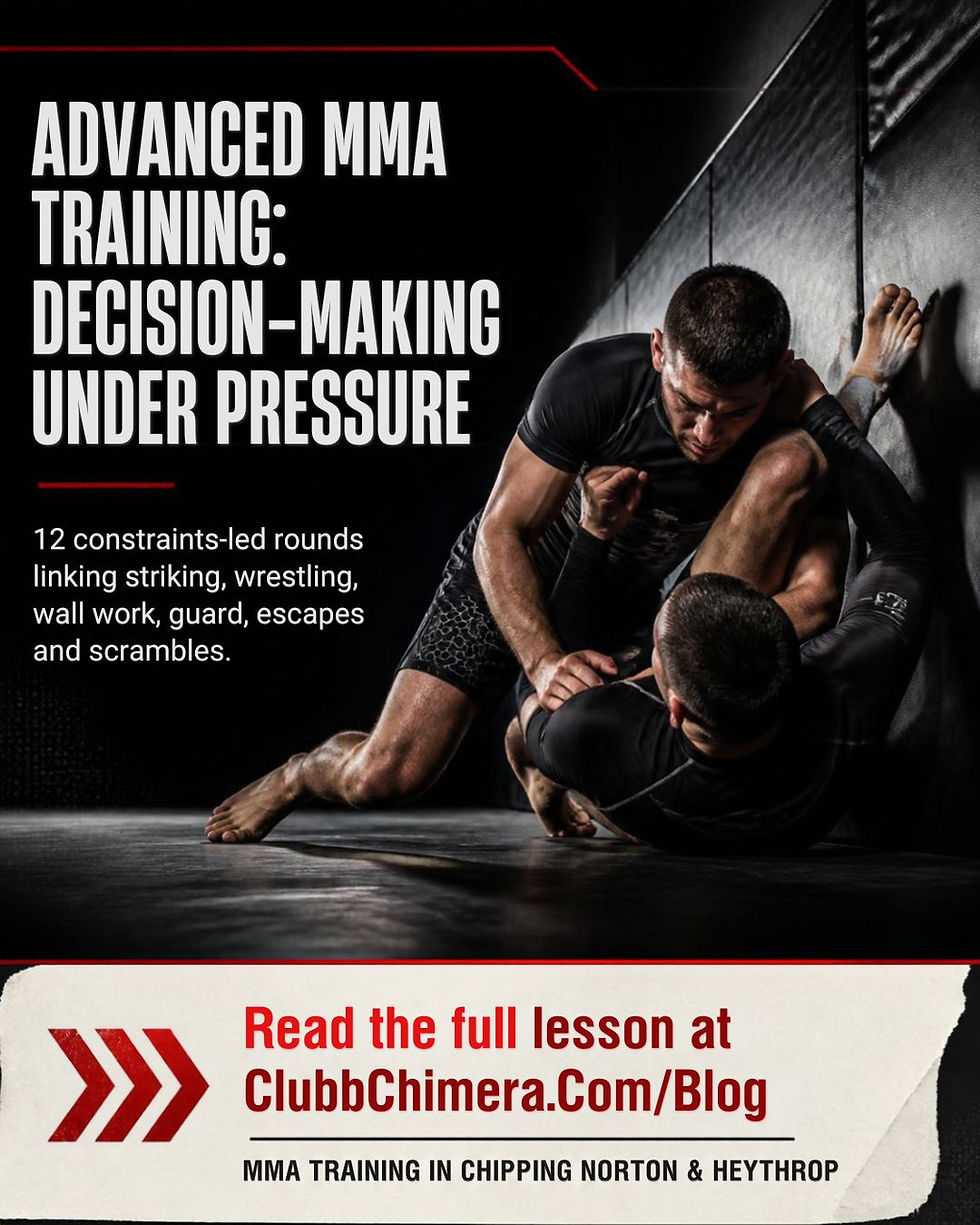
MMA
Advanced training should sharpen decisions, not just add more techniques.
The sixth lesson in this block kept that principle at the centre. We worked through 12 rounds of constraints-led games, each one built around a common fight problem. The rules were tight. The feedback was immediate. Students had to solve the problem under pressure, then swap roles and learn the other side.
This is where mixed martial arts training becomes more than a list of moves. The jab becomes an entry. The wall becomes a wrestling problem. Guard becomes a shield. A low kick becomes a counter chance. Turtle becomes a temporary stop, not a hiding place. Scrambles become moments to finish or reset.
The lesson aim was decision-making under pressure
A constraints-led game uses rules to shape behaviour. Instead of saying, “Do this exact technique,” the coach sets a task with limits.
For example:
One person may only enter after a jab.
One person must keep their back near the wall.
One person must escape turtle without turning flat.
One person scores by standing up, passing, or finishing.
The constraints make the student notice what works. They also expose bad habits fast.
This lesson was advanced because the games linked phases together. Striking led to wrestling. Wrestling led to wall work. Wall work led to guard. Guard led to scrambles. That is how a live contest behaves. Clean categories break down when resistance enters the room.
The class worked in short rounds. Roles changed after each round or after a clear score. That mattered. Each student felt both sides of the exchange. This builds understanding faster than drilling one preferred role all evening.
The useful question is not “Do I know the move?” The useful question is “Can I find it when someone is trying to stop me?”
Rounds 1 to 4 built the bridge from jab to wall control
Rounds 1 and 2 worked the jab-entry gate
The opening game focused on a simple attacking chain, jab first, takedown second.
The jab was not thrown as decoration. It had to create a gate. A gate is a brief opening in posture, distance, or attention. The takedown could only be attempted after a meaningful jab. A touch with no effect did not count.
The attacking player had three goals:
Land or draw a reaction with the jab.
Step into takedown range without reaching.
Connect hands or body position before the defender reset.
The defender had three goals:
Read the jab early.
Keep balance and stance.
Deny the entry by moving, framing, or countering.
The task constraints were clear. The attacker could not shoot from too far away. They had to jab first. The defender could strike back with controlled contact, but their main score came from making the attacker miss the entry or sprawl without collapsing.
After each committed entry, roles swapped. If the attacker completed a clean takedown or drove the defender into a controlled clinch, they stayed in the attacking role for one more attempt. This reward kept the pressure on.
The key lesson was honest distance. Many students can jab. Many can practise a takedown. The problem appears in the space between them. If the jab leaves the head high, the entry is exposed. If the feet lag behind the jab, the shot becomes a reach. If the jab lands but the attacker admires it, the window closes.
Good entries came from three details:
The jab disturbed the defender’s rhythm.
The lead foot gained ground.
The head moved off the centre line during entry.
No speech could teach that as well as the game. The rules made the lesson unavoidable.
Rounds 3 and 4 moved to the cage wall under-hook
The second game moved the fight to the wall. In a room without a cage, a padded wall can do the job. The aim was to secure under-hooks against the barrier.
An under-hook means placing an arm under the opponent’s arm to control their body. It is a basic wrestling position, but basic does not mean easy. Against the wall, under-hooks decide whether a person can turn, stand, trip, reverse, or escape.
The modified task constraints changed the problem.
The attacker started with the defender’s back near the wall. The attacker scored by gaining one or two under-hooks and pinning the defender’s hips or shoulders long enough to start a takedown. The defender scored by getting an under-hook back, turning off the wall, or creating enough space to disengage.
Strikes were limited to light body touches. This preserved the mixed range without turning the game into a messy exchange. The point was wall wrestling, not winning a sparring round.
Roles swapped when:
The defender escaped the wall.
The attacker secured control and completed a takedown.
The defender reversed position and put the attacker on the wall.
A stalemate lasted too long.
The best work came from students who used head position with their under-hooks. An under-hook without head control can become a loose arm. An under-hook with forehead pressure, hip pressure, and foot position becomes a steering wheel.
The common error was reaching for high under-hooks while standing square. That gave the defender space to pummel back inside. The better answer was lower shoulder pressure, near hip contact, and short steps. The wall punishes big movements. It rewards pressure, patience, and small gains.
Rounds 5 to 8 tested defence that turns into attack
Rounds 5 and 6 used the feet-on-hips shield
The third game began on the ground. The defender played from open guard with both feet near the attacker’s hips. This is the feet-on-hips shield.
For newer readers, guard means the bottom person uses legs, hips, frames, and grips to manage an opponent on top. Guard retention means stopping the top person from passing the legs and settling into a stronger position.
This round made guard retention active. The bottom player was not allowed to hold and wait. They had to recover position, off-balance the passer, or create a stand-up. The top player had to pass the legs, pin the hips, or force the bottom player to turn away.
The task constraints created a narrow but rich problem.
The bottom player started with feet on the hips and hands framing the shoulders or arms. They scored by keeping the passer outside their hips for a set time, recovering both feet between the bodies, or moving to a safe stand-up. The top player scored by clearing the legs and controlling the chest or hips.
The role swap happened after a clean pass, a successful stand-up, or a guard recovery followed by a clear reset.
The feet-on-hips shield teaches several facts fast:
Straight legs are weak when the hips are flat.
Bent knees can absorb pressure and redirect it.
Frames must connect to hip movement.
The bottom player must not let both knees point the wrong way.
The strongest guard retention came from students who moved their hips before they felt trapped. Waiting until the passer had chest pressure was too late. The game punished late defence. That was the point.
This section also showed why private lessons can help. A small angle in the foot, knee, or hip can decide whether the shield works. In personal training, the coach can correct that angle without stopping a whole class.
Rounds 7 and 8 trained the low-kick counter
The fourth game returned to standing. The focus was checking leg kicks and answering at once.
A check means raising the leg so the shin meets the incoming kick. It reduces damage and can make the kicker pay a price for poor timing. The counter matters. A check without a counter only resets the exchange. A check with an answer changes the cost of the kick.
The task constraints were simple. One player could attack with low kicks and set them up with light punches. The defender could only score after checking, evading, or jamming the kick. Random counters did not score. The defence had to cause the counter.
Useful counters included:
Check and jab.
Check and cross.
Check and step into a body lock.
Pull the leg back and return a kick.
Jam the kick and enter to clinch.
Roles swapped after three clear low-kick attempts, a clean counter score, or a loss of balance. The attacker learned how hard it is to kick without preparation. The defender learned that checking is not a statue pose. The hips, guard, eyes, and return step all matter.
A common mistake was lifting the leg and dropping the hands. That invites punches. Another was checking too high and turning the body away. That kills the counter. Better defence kept the stance alive. The checking leg returned to the floor under control, ready to strike or wrestle.
This round connected well to the jab-entry gate. If the defender overreacted to the low kick, the attacker could enter. If the attacker kicked lazily, the defender could crash into a takedown. The game made both players more careful.
Rounds 9 to 12 joined escapes, scrambles, and finishes
Rounds 9 and 10 focused on the turtle exit
Turtle is the position where a person is on hands and knees, usually protecting the neck and trying not to be flattened. It is common after a failed takedown, a guard pass, or a scramble.
The aim was not to live in turtle. The aim was to exit.
The defender started in turtle. The attacker started on the side or behind, with controlled contact. The attacker scored by taking the back, breaking the defender flat, or finding a safe finishing position. The defender scored by standing, recovering guard, turning into the attacker, or reaching a front head position without giving up the neck.
The constraints prevented passive hiding. The defender could not stay balled up. The attacker could not strike freely. Light touch strikes were allowed only to create movement, not to overwhelm the drill.
Roles swapped when:
The defender escaped to a stable position.
The attacker secured back control.
The attacker flattened the defender and held control.
The defender turned in and forced a reset.
The main coaching point was elbow and knee connection. When the defender’s elbow drifted away from the knee, hooks entered. When the neck lifted without hand protection, the attacker reached around. When the defender moved on a straight line, the attacker followed.
Better exits used angles:
Sit through to guard.
Build to one foot and stand.
Turn into the attacker’s chest.
Trap a hand before rolling.
Clear hooks before escaping hips.
The turtle round also revealed character. Some students rush and expose the neck. Others freeze and accept control. The game rewarded calm urgency, a useful phrase in combat training. Move now, but do not panic.
Rounds 11 and 12 finished with the scramble reset
The final game linked the whole session. It began from broken positions. One player might be half past the guard. Another might be coming up from a shot. One might have a loose body lock. Neither had full control.
The task was to win the scramble or reset safely.
The attacker scored by finishing a takedown, taking the back, passing guard, or landing in a clear control position. The defender scored by standing, facing the opponent, recovering guard, or reversing position. If both players reached a neutral stance, the round reset and started again from a new broken position.
The role swap happened after each score. This kept both students alert. No one could specialise in only attacking or only escaping.
This game exposed the real value of the previous rounds. The jab-entry showed how to enter. The wall under-hook showed how to control pressure. The feet-on-hips shield showed how to retain guard. The low-kick counter showed how to answer in transition. The turtle exit showed how to escape before control becomes complete.
Now it all had to happen without a script.
Finishing in a scramble means recognising a clear advantage before it vanishes. Resetting means refusing a bad chase. Both are skills.
A student who clings to a weak grip can lose position. A student who releases too early can miss a takedown. A student who stands with their hands low can get hit on exit. The scramble reset game makes those choices visible.
What this lesson teaches about advanced training
This was not a session built around collecting techniques. It was built around pressure, feedback, and adaptation.
That is why constraints-led coaching fits combat sports so well. A fight is not a quiet demonstration. It is a moving argument. Each person is trying to deny the other person’s plan.
The sixth lesson gave students repeated exposure to key problems:
Training problem | Game used | Main lesson |
Entering safely after strikes | Jab-entry gate | The jab must create a real opening |
Controlling the wall | Cage wall under-hook | Under-hooks need head, hip, and foot pressure |
Keeping guard alive | Feet-on-hips shield | Frames work when the hips move |
Defending kicks | Low-kick counter | A check should lead to an answer |
Escaping bad positions | Turtle exit | Turtle is a route out, not a resting place |
Linking phases | Scramble reset | Finish when ahead, reset when danger builds |
For new clients looking at Mixed Martial Arts, Personal Training, Private Lessons offer a clear way to study these details at the right pace. Group rounds build pressure. One-to-one coaching can slow the problem down, correct the key error, then return it to live practice.
For more information about training options in the Chipping Norton and Heythrop area, visit the MMA training page.
FAQ
Is this type of session suitable for beginners?
This lesson was advanced. A beginner can use the same method with simpler rules, lighter resistance, and fewer positions. The coach should control the pace and contact level.
Why use games instead of fixed drills?
Fixed drills teach shape. Games teach timing, judgement, and adjustment. Both have value, but live constraints show whether a technique survives resistance.
Do these rounds include striking contact?
Yes, but contact can be controlled. In this session, some rounds used light touch strikes to create realistic reactions without losing the main focus of the game.
What does role swapping add?
Role swapping teaches both sides of the problem. A student who defends a takedown learns how entries fail. A student who escapes turtle learns what makes back control dangerous.
How does private coaching help with this material?
Private coaching gives more time for individual correction. Small details, such as foot angle, head position, or hip movement, can be addressed before they become habits.
The takeaway from lesson six
The sixth lesson tied the block together. Each round forced a decision under pressure. Jab and enter. Fight for the wall. Retain guard. Check and counter. Exit turtle. Win the scramble or reset.
That is the point of advanced training. The student learns to solve the fight that is happening, not the one they hoped would happen.


Comments