


Some Historical Inspiration (diary entry)


The third lesson of my client’s weapons for martial arts cross-training began with single stick-on-stick work. Although it is not beyond the realms of possibility that you may find yourself having defend against a blunt weapon with a blunt weapon of your own, this type of training usually falls in the “art” side of things. In essence, we go back to cultural duelling working basic angles against each other to acquire attributes rather than looking for direct application to “real-life” violence. They are certainly functional and economical movements, but their context is within duelling. We warmed up with single stick and then moved onto double-stick, going through different ranges, before moving onto some empty hand application.
The main focus of training was on three technique combination. We looked at variants on this pattern, but the main point was getting the rhythm and timing. It helped aid tactical awareness from a striking and grappling perspective. The fighter both attacked limbs and trapped them. We looked it flowing into single knife-on-knife, double stick, arm-drags and clinching, moving into takedowns.
We then looked at first and second striking angles – which take the form of a criss-cross or figure-of-eight hand movement - using one hand followed by a rear hand stab. We began with the Filipino-style approach. However, this is close to a universal tactic found in just about every culture that has employed the use of two weapons simultaneously.
Spanish Fencing was refined through the Italian and French schools eventually becoming the Olympic sport of today. It also made its way over the Spanish colony of the Philippines, named after the Spanish King Phillip II. Here it went through a different hybridization, blending with indigenous systems and the strong bladed nature of the country’s agricultural way of life. Rattan cane sticks were first used as safe practice tools, replacing the knives, but later became weapons in their own right. Such a development occurred with Europe’s Short-Stick defence methods and Japan’s bokken. However, the Filipino’s developed it perhaps to the highest level of sophistication. As with their blade-work, an ambidextrous style of fighting emerged. Renaissance-style fencers used a dagger in their rear hand, the lead hand held the sword and did most of the work.
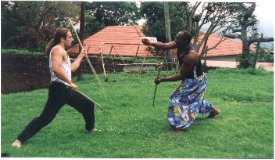
The most obvious example is the sword or spear and the shield. Zulu stick fighting, which we also briefly covered, employs a long leading stick, which is used for blocking and a much shorter stick at the rear that is used in a whipping action. Such a tactic was also employed in medieval and renaissance hand-to-hand fighting when the buckler was employed. This small shield-like weapon had a variety of uses besides parrying and blocking. We can the use of this weapon across Europe and notably as part of the German School of Fencing, which might be the birthplace of English Boxing. Taking this lead and inspiration from the Filipino styles we moved onto Western Boxing simple combinations, using multiple jabbing attacks to set up for the cross.


Comments