


Submission Grappling: The Closed Guard Arm-Bar Through Three Ecological Games

Submission Grappling
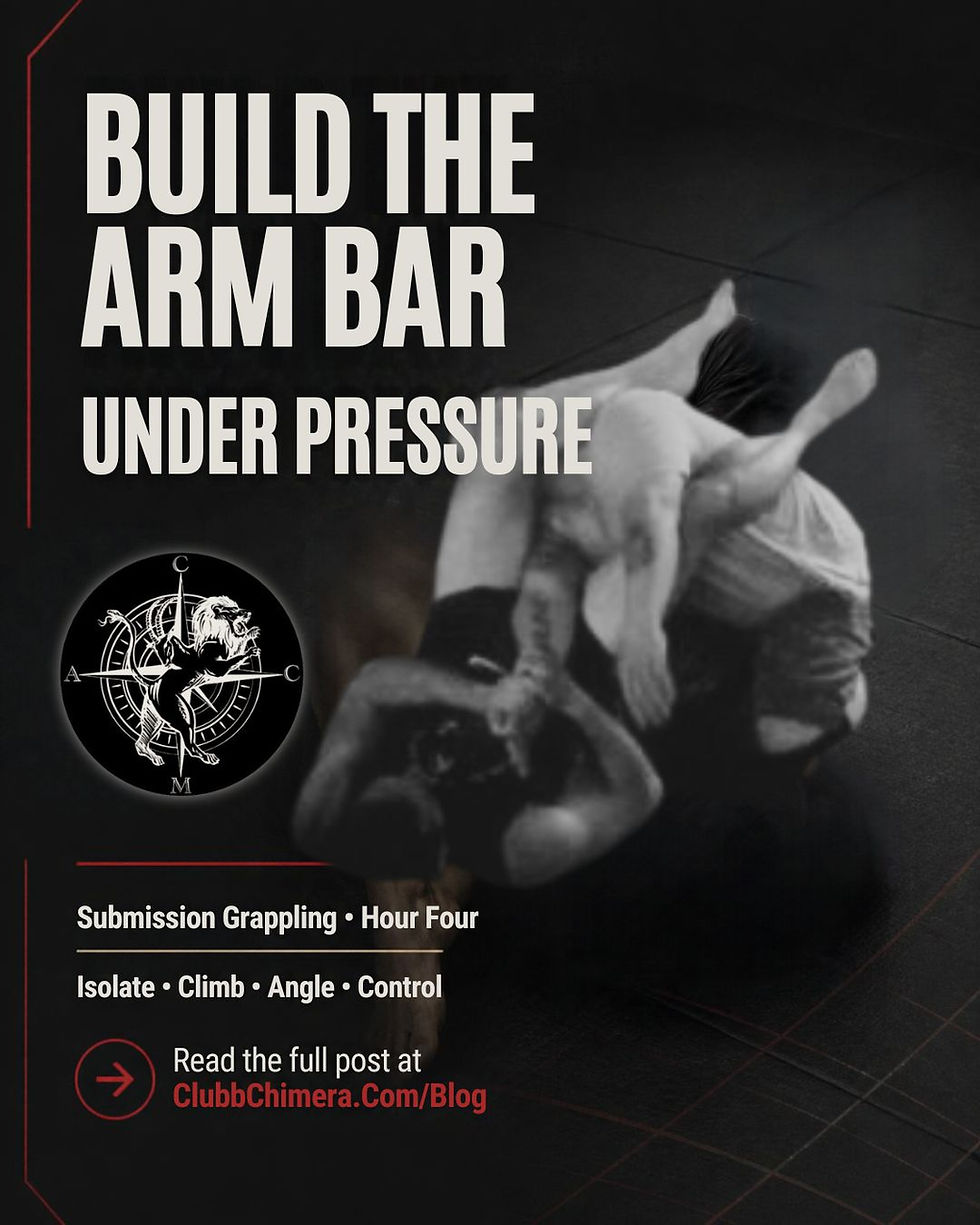
Hour four moved the class from holding close guard to attacking with purpose. The main target was the arm bar from close guard, but the lesson was not built around copying a fixed sequence. It was built around three games that forced students to find the arm, climb the body, change the angle, and finish with control.
The arm bar is a useful lesson tool because it teaches several core ground-fighting skills at once:
Breaking posture
Controlling one side of the body
Using the legs as clamps and levers
Turning the hips to create an angle
Finishing only when the partner is controlled
This was part of the second Submission Grappling and Ground-Fighting course, taught as a progressive class. Each hour builds on the last. Hour four asked students to connect grip fighting, guard retention, and submission control under resistance.
The method was ecological. That means the students did not start by memorising a long list of steps. They learned through live problems with clear limits. The task shaped the behaviour.
The aim of hour four was to build the arm-bar from closed guard
Close guard places one player on their back with their legs wrapped around the partner’s waist. The top player is inside the guard and wants posture, balance, and escape. The bottom player wants control, off-balancing, and attacks.
The arm bar from this position works when the bottom player isolates one arm and uses the hips and legs to attack the elbow joint. In practice, the submission depends less on pulling with the arms and more on controlling the partner’s posture and shoulder line.
The class worked through three linked games:
The One-Arm Lockdown
The Over-the-Shoulder Climb
The Angle & Squeeze
Each game narrowed the problem. Each one gave students a clear way to score. This made success visible. It also showed where the movement broke down.
That matters in private martial arts classes. Progress is easier to measure when a student knows exactly what changed. A student might not finish the arm bar on day one, but they can learn to trap the arm, climb higher, or turn the hips at the right time.
The One-Arm Lockdown taught students to isolate the target arm
The first game dealt with the most common failure point in the close guard arm bar. Students often try to attack both arms at once. This gives the top player too many escape routes.
The One-Arm Lockdown forced the bottom player to control one arm and keep it controlled.
How we set it up
Both partners started in close guard.
The bottom player wrapped their legs around the top player’s waist. The top player began with both hands available, either on the body or floor, but without striking.
The bottom player’s goal was to trap one of the top player’s arms across the centre line or pin it to the body. The top player’s goal was to recover posture, free the arm, and square up.
The game began at a moderate pace. This allowed students to feel hand positions, head position, and body weight without rushing.
The task constraints
The rules were simple:
The bottom player could not open the guard to attack the legs or stand up.
The bottom player could not finish a submission yet.
The top player could not simply stall by clamping both elbows to the ribs.
The top player had to work to regain posture or free the trapped arm.
Both players had to keep movement safe and controlled.
The key restriction was that the bottom player had to win the arm before progressing. No arm control, no attack.
This stopped the common habit of throwing the legs up without a grip. It also stopped students from chasing the neck when the lesson goal was the arm bar.
The scoring
The bottom player scored when they held one arm isolated for a clean three-count. The arm could be trapped across the centre line, pinned to the chest, or controlled with a strong two-on-one grip.
The top player scored when they freed the arm and returned to a stable upright posture.
A round lasted short bursts. Around 30 to 60 seconds works well for this type of game. Short rounds keep effort high and reduce sloppy movement.
The ecological focus
The game shaped attention towards arm isolation under pressure.
Students learned that the arm is easier to control when posture is broken. They also learned that the hands alone are not enough. The chest, head, knees, and hips all support the trap.
The bottom player began to feel when the top player’s elbow drifted away from the body. That opening matters. In live grappling, submissions rarely appear as clean gifts. They appear as small gaps.
The top player learned the opposite lesson. Good posture protects the arm. Keeping elbows connected to the body makes the attack harder. This gave both players useful feedback, not just the person attacking.
The Over-the-Shoulder Climb taught students to move higher on the body
Once the arm was isolated, the next problem was position. Many beginners try to finish an arm bar from too low on the body. They pull at the wrist while their hips stay flat. The top player then stacks, turns, or pulls the elbow free.
The Over-the-Shoulder Climb taught students to climb their guard higher and control the shoulder line.
How we set it up
The game started from close guard with one arm already partly controlled. The bottom player had a grip on the chosen arm. The top player began with posture partly broken, not fully upright.
The bottom player’s task was to climb the legs up the back and shoulders. The goal was to bring one leg high over the upper back while keeping the target arm trapped.
The top player’s task was to lower the bottom player’s legs, rebuild posture, and recover the trapped arm.
The task constraints
The bottom player could use their legs, hips, and upper body grips. They could not switch to a triangle choke or back take. The attack line stayed focused on the arm bar.
The top player could defend with posture, elbow recovery, and safe stacking pressure. They could not slam, yank, or twist the partner’s arm.
The bottom player had to keep the arm. If the arm escaped, the climb no longer counted.
This forced a clear order:
Control the arm
Break the posture
Climb the legs
Keep the knees tight
Move the hips into a stronger attacking position
The scoring
The bottom player scored when they got a leg over the shoulder line while keeping the target arm trapped. A stronger score came when both knees closed tightly around the upper body with the opponent’s posture broken.
The top player scored by freeing the elbow past the hip line or returning to upright posture with both arms safe.
This scoring kept the game honest. Students could not claim progress just because a leg moved high for a moment. They had to control the partner while climbing.
The ecological focus
The main focus was climbing without losing connection.
This is a critical grappling idea. Movement without connection gives the opponent space. Connection without movement leads to a stalemate. The arm bar needs both.
Students learned to use their legs like active tools, not passive hooks. The legs pulled the top player in, climbed the back, and helped turn the body. The hips followed the grip work.
The game also taught students to notice shoulder height. When the top player’s shoulders rose above the bottom player’s hips, the attack weakened. When the bottom player climbed their hips closer to the shoulder line, the arm bar became more realistic.
This is where Personal Training, Martial Arts, Ground Fighting can be adapted well. A private lesson can slow the game down, change the starting position, and adjust resistance to match the student’s current level.
The Angle & Squeeze taught students to finish with control
The final game joined the earlier pieces. The arm was trapped. The body had climbed. Now the bottom player needed the finishing angle.
A close guard arm bar does not work well when both bodies stay square. The bottom player needs to turn. This changes the line of the hips and puts pressure through the trapped arm.
The Angle & Squeeze game taught students to create this angle and close the space before extending.
How we set it up
The students began with one arm isolated and the guard already climbed high. The bottom player had permission to move towards the final arm bar position.
The top player defended by stacking safely, pulling the elbow free, turning the thumb, or stepping around to reduce pressure. The focus stayed technical. No explosive escapes.
The bottom player aimed to angle off, place the leg over the head, squeeze the knees, and control the wrist line before applying any finishing pressure.
The task constraints
The bottom player could only finish if the knees were tight and the partner’s posture was controlled. They could not fall back loosely and crank the arm.
The top player could defend, but had to respect the tap. The person being attacked could tap with the free hand, foot, or voice. That rule was stated clearly.
The finish was applied slowly. The class goal was learning, not forcing a submission.
The constraints made students check their position before chasing the tap:
Is the elbow trapped?
Are the knees tight?
Is the thumb line controlled?
Has the body turned enough?
Is the head controlled by the leg?
If those answers were missing, the student returned to control rather than pulling harder.
The scoring
The bottom player scored one point for reaching the correct arm bar position with control. They scored a second point if the partner tapped to a slow, safe finish.
The top player scored by clearing the elbow, stacking safely until the attack was lost, or turning into a stable defensive position.
This scoring separated position from submission. That is useful. A student can learn that reaching the position is progress, even before the finish becomes reliable.
The ecological focus
The focus was angle, squeeze, and timing.
The bottom player learned to turn before extending. They also learned that the squeeze of the knees matters more than pulling with the arms. A loose arm bar gives space. Space gives defence.
The top player learned early warning signs. If the arm crosses the centre line, posture breaks, and the attacker climbs high, danger is close. This improves defence and makes future rounds more realistic.
The ecological value came from the live decision making. Students had to feel when to turn, when to clamp, and when to abandon a poor attack. That cannot be learned from static drilling alone.
Key learning outcomes from the session
The hour produced several useful outcomes.
Students learned to attack in stages. The arm bar was no longer one large movement. It became a chain of smaller tasks: isolate, climb, angle, squeeze, finish.
Students learned to value control before submission. A rushed finish creates gaps. A controlled attack reduces escape options.
Students improved their use of the legs. In close guard, the legs are not just holding the opponent in place. They break posture, climb, clamp, and steer.
Students learned practical defence. The top player did not act as a dummy. They learned posture, elbow position, and safe escape habits.
Students gained live feedback. Each game showed what worked and what failed. That is more useful than guessing why a technique did not land.
For new students, this approach removes a lot of confusion. The arm bar becomes a problem to solve, not a string of moves to remember under stress.
Practical applications for private students
This lesson format works well in private training because the coach can tune the games quickly.
If a student struggles to trap the arm, more time goes into The One-Arm Lockdown. If they trap the arm but stay flat, the lesson shifts to The Over-the-Shoulder Climb. If they reach the position but lose the finish, The Angle & Squeeze becomes the main game.
That makes the session efficient. It also keeps training honest. The partner resists within clear limits, so the student learns timing and pressure without being overwhelmed.
For students training near Chipping Norton, this type of ground-fighting lesson offers a clear route into grappling. It builds skill through contact, feedback, and safe resistance.
For more information on private and small-group grappling training, visit Clubb Chimera Submission Grappling.
FAQ
Is the closed guard arm bar suitable for beginners?
Yes, if it is taught with control. Beginners should learn posture, arm isolation, and safe tapping before applying the finish.
Do I need previous grappling experience?
No. The games can be scaled. A new student can start with light resistance and simple scoring.
Why use games instead of fixed drills?
Games create live problems. Students learn when a movement works, not just what it looks like.
Is submission training safe?
It can be trained safely with clear rules. Partners must apply pressure slowly, respect the tap, and avoid sudden force.
What should I focus on first?
Start with arm control. Without isolating the arm, the rest of the attack becomes weak.
The main takeaway from hour four
The close guard arm bar is not just a submission. It is a teaching tool for control, timing, posture breaking, and pressure.
Hour four used three games to make those lessons clear. The One-Arm Lockdown taught isolation. The Over-the-Shoulder Climb taught connection and height. The Angle & Squeeze taught the finish.
The result was a more practical arm bar. Students did not just learn where to put their limbs. They learned how to make the attack appear under resistance.


Comments