


Constraints Led Guard Games for Submission Grappling Beginners

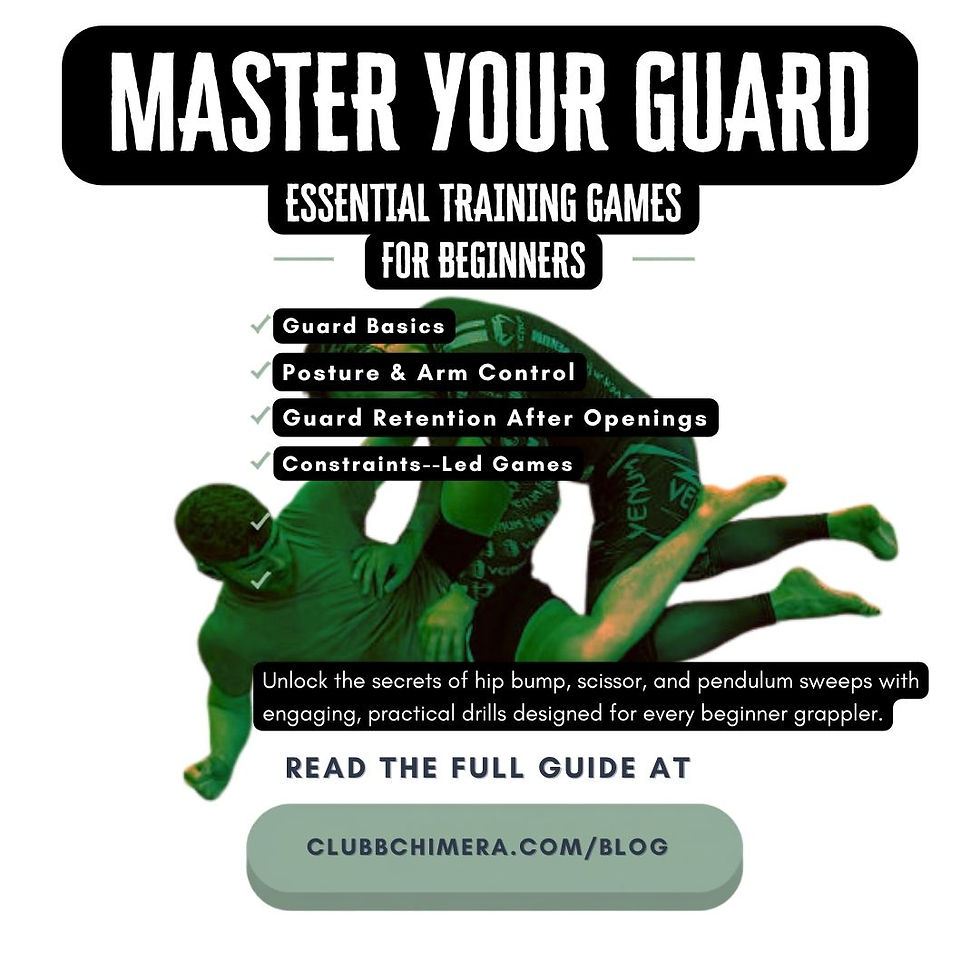
The first time someone learns guard, it’s tempting to give them a long list of instructions. Grip here. Move your hip there. Pull this elbow. Turn at this angle.
The problem is that a beginner can only hold so many details in their head while another person is trying to push, pin, pass or squash them.
Tonight, my client began his second submission grappling course with me. The first course was all about top position ground fighting, mainly attacking and defending against pins. That gave him a useful base: how pressure works, how pins feel, and why being on top is usually safer.
This course changes the problem. Now we’re looking at the guard.
In simple terms, guard is a bottom position where you use your legs to manage the person on top. It’s not just “lying on your back”. A good guard can slow someone down, break their balance, keep you safer, and create chances to reverse the position.
Rather than starting with a full technique lesson on the hip bump sweep, scissor sweep and flower or pendulum sweep, we began with constraints-led games. That means each round had a clear rule that forced the right problems to appear.
No long lecture. No memorising a perfect sequence. Just a small game where the body has to solve the problem.
Why constraints-led games work so well for beginners
A constraint is just a rule that changes the task.
For example, if the top player isn’t allowed to put their hands on the mat, they have to balance differently. If the bottom player has to trap an elbow for three seconds, they start learning why arm control matters. The rule creates the lesson.
This style fits what we know from motor learning. People usually learn movement better when practice keeps the real problem alive. In grappling, that means pressure, timing, balance and resistance. Static drilling has its place, but if a beginner only repeats shapes with no resistance, they can struggle the moment their partner moves differently.
Constraints-led practice gives a beginner three useful things:
A clear goal
The round has a simple win condition. Trap an arm. Break posture. Make the top player touch a hip to the mat.
Live feedback
If the movement works, the opponent moves. If it doesn’t, nothing happens. That feedback is immediate and honest.
Less overthinking
Instead of trying to remember ten coaching points, the beginner feels what matters.
This is especially useful in Submission Grappling personal training because the game can be adjusted in real time. If the task is too easy, the top player adds resistance. If it’s too hard, the rule changes so the right movement has a chance to appear.
The aim is not to avoid technique. The aim is to make technique mean something before naming every detail.
Game one builds posture control from closed guard
The first game was the Posture vs Breakdown Battle.
The bottom player starts with closed guard. That means their legs are wrapped around the top player’s waist, with the ankles crossed behind the back. The top player stays on their knees.
The rules were simple:
The top player cannot stand up.
The top player cannot put their hands on the mat.
The bottom player tries to break the top player’s posture.
The top player tries to drive weight forward and make a chest-to-chest connection.
This game teaches one of the biggest early guard lessons: the legs and hips do a lot of the work.
Many beginners try to pull the top player down using only their arms. That gets tiring fast. It also fails against anyone with decent posture. The stronger lesson is that the bottom player can use their legs as heavy hooks around the body, lift and tilt with the hips, and keep the top player’s weight from settling where they want it.
A common coaching cue for breaking posture is to pull the opponent’s head or arms down. That can help, but it can also turn into a tug-of-war. In this game, the student starts to feel the difference between pulling with the arms and moving the whole body.
When the top player tries to drive forward, the bottom player learns to ask simple questions through movement:
Can I make their spine bend?
Can I stop their chest staying tall?
Can I make their head come past their hips?
Can I use my legs to carry some of their weight?
That last point matters. If the top player’s head and shoulders come too far forward, their balance becomes easier to attack. This is the soil that later grows hip bump sweeps, pendulum sweeps and other attacks from guard.
The technique comes later. The feeling comes first.
Game two teaches that arm control is balance control
The second game was the Elbow Isolation Game.
Again, the top player starts on their knees inside the guard. Their job is to free their arms, posture up, open the guard or pass. The bottom player’s job is to trap one of the top player’s arms against their own body for three seconds.
That’s it. Win the arm. Hold it briefly. Reset.
This sounds small, but it’s huge.
Most sweeps from closed guard need some form of control over a limb. If the top player can freely post their hand on the mat, they can often stop themselves falling. A “post” is simply a hand, elbow, knee or foot used to catch balance.
So, if the bottom player wants to sweep, they usually need to remove or weaken a post.
The Elbow Isolation Game teaches that without turning the lesson into a lecture. The bottom player discovers that trapping an arm is easier when they use more than their hands. They can pull with the legs, curl their back slightly, angle their hips, and bring the opponent’s elbow away from a strong position.
A useful example is the flower or pendulum sweep. In that sweep, the bottom player often controls one arm, opens their guard, swings a leg to create momentum, and turns the top player over the shoulder on the trapped-arm side.
If the top player has that arm free, they can post. If the arm is trapped, the sweep has a much better chance.
That’s why this little game matters. It teaches the beginner:
Arms are not just things to grab.
Elbows tell you where balance is going.
A trapped arm makes one side weaker.
Pulling with the legs saves arm strength.
It also makes the round feel playful. Beginners often relax when the target is narrow. “Trap one arm for three seconds” is easier to understand than “set up a complete sweep with correct timing, angle and grips”.
Once the student can consistently isolate an elbow, the named sweeps start to make more sense.
Game three introduces the missing post
The third game was the 1-Hand / 1-Knee Sweep Drill.
The top player starts with one hand and one knee on the floor. The bottom player’s goal is to off-balance them until they’re forced to touch a hip to the mat.
This game is a clean way to teach the idea of a missing post.
Imagine a table with four legs. Take one leg away, then push it towards the missing corner. It tips. Grappling balance works in a similar way. If the top player has strong posts on the floor, they’re harder to move. If one post is missing or trapped, there’s a weaker angle.
The bottom player doesn’t need to know every sweep name yet. They only need to feel this:
If I block the place they want to catch themselves, I can move them into that space.
That feeling is at the heart of many beginner sweeps.
For the hip bump sweep, the bottom player often sits up and drives into the top player at an angle, especially when the top player’s weight is slightly back or one arm is limited.
For the scissor sweep, the bottom player uses one leg to load and steer the top player while the other leg cuts through the base. The top player falls because their weight is moved past the point where their knee and hand can save them.
For the flower or pendulum sweep, the bottom player combines arm control, hip movement and a swinging leg to roll the top player into the space where they can’t post.
Different sweeps. Same basic idea.
Take away a post, move them towards the empty space, come up on top.
The 1-Hand / 1-Knee Drill keeps that idea honest. The top player is not pretending to fall. The bottom player has to adjust until the balance breaks. Sometimes the angle is wrong. Sometimes the timing is late. Sometimes the top player’s weight is too settled.
That’s all useful information.
Better still, the student gets to recognise the moment before the sweep. That moment matters more than the finished shape. A lot of beginners try to “do the move” when the opponent’s balance is still strong. This game teaches them to hunt for the balance break first.
Game four keeps the guard alive after it opens
The fourth game was Guard Retention After Opening.
This one deals with a common beginner panic moment: the ankles get separated.
In closed guard, crossed ankles can feel like a safety belt. When the top player opens that lock, many beginners freeze. Then the top player starts passing, which means moving around the legs into a stronger pinning position.
The rules here were:
The top player actively tries to separate the ankles and pass.
The bottom player tries to re-lock closed guard.
If closed guard is fully opened, the bottom player can use a knee shield.
A knee shield is when the bottom player places a knee across the top player’s body to make space. It can slow the pass and create a frame, meaning a structure that holds the opponent away without needing to bench press them.
This game teaches a crucial beginner habit: guard is not one fixed position.
If the closed guard opens, the bottom player still has options. They can frame with their arms, move their hips away, bring a knee inside, turn to face the top player, and re-close the guard if the chance appears.
That matters because real grappling is messy. The first defence fails. A foot slips. A grip breaks. The top player changes angle. A beginner needs permission to keep working rather than treating the first lost position as the end of the round.
This is also where earlier lessons join together.
The bottom player still needs posture control because a tall opponent is harder to hold. They still need elbow control because free hands help the pass. They still need to understand posts because guard recovery often means making the top player adjust their base.
Nothing sits in isolation.
How these games connect to the first few guard sweeps
The goal of the session wasn’t to perfect three sweeps in one night. That would be too much, especially for someone at the start of a new course.
The goal was to build the foundations that make those sweeps possible.
Here’s how the games link together:
Guard game | Main lesson | Sweep connection |
Posture vs Breakdown Battle | Use hips and legs to bend or move the top player | Sets up attacks by weakening posture |
Elbow Isolation Game | Trap a limb and reduce the top player’s ability to post | Helps hip bump, scissor and flower sweeps |
1-Hand / 1-Knee Sweep Drill | Move the opponent towards a missing post | Teaches the basic direction of a sweep |
Guard Retention After Opening | Recover when the guard starts to fail | Keeps the bottom player attacking and defending |
This order is deliberate. If a beginner can’t affect posture, they struggle to attack. If they can’t control an arm, the top player posts. If they don’t understand balance, sweeps feel like magic tricks. If they panic when the guard opens, they never get enough time to learn.
Working through games lets those lessons stack naturally.
For anyone looking at Private lessons for martial arts, ground-fighting is often easier to learn this way because the pace can match the student. One round might focus on posture. The next might bring in an arm trap. Then a sweep appears because the situation calls for it, not because it was forced.
FAQ
What is closed guard in submission grappling?
Closed guard is a bottom position where the legs are wrapped around the top player’s waist, with the ankles crossed. It helps the bottom player control distance, slow the top player down, and set up attacks.
Do beginners need to learn sweeps before submissions?
Usually, yes. Sweeps teach balance, control and position. Submissions are easier to understand when the beginner already knows how to stop the top player from posturing, passing or escaping.
Are constraints-led games safe for new students?
They can be, when the rules are clear and the intensity is sensible. The coach should choose simple goals, match partners carefully, and stop the round if movement gets uncontrolled.
Why not just teach the full technique straight away?
Full techniques matter, but beginners often copy the shape without understanding the reason. A short game helps them feel the problem first. After that, the technique has context.
How long should each guard game last?
Short rounds work well. One to three minutes is often enough for beginners, especially when the goal is specific. Reset often, give quick feedback, then play again.
The main takeaway from tonight’s session
Guard can look complicated from the outside. There are grips, angles, sweeps, submissions, frames and recoveries. But the early lessons are much simpler.
Break posture. Control a limb. Remove a post. Move your hips. Recover when the guard opens.
Those ideas showed up again and again tonight through simple games. That’s the value of constraints-led training. The student doesn’t just hear the answer. They meet the problem, test a solution, and feel why it works.
For a beginner, that feeling is gold. Once it’s there, the hip bump sweep, scissor sweep and flower sweep stop being random techniques. They become natural answers to problems the student already understands.


Comments