


Maximise Your Muay Thai Personal Training with Effective Clinch Sparring and Posterior Chain Workouts

Muay Thai Personal Training
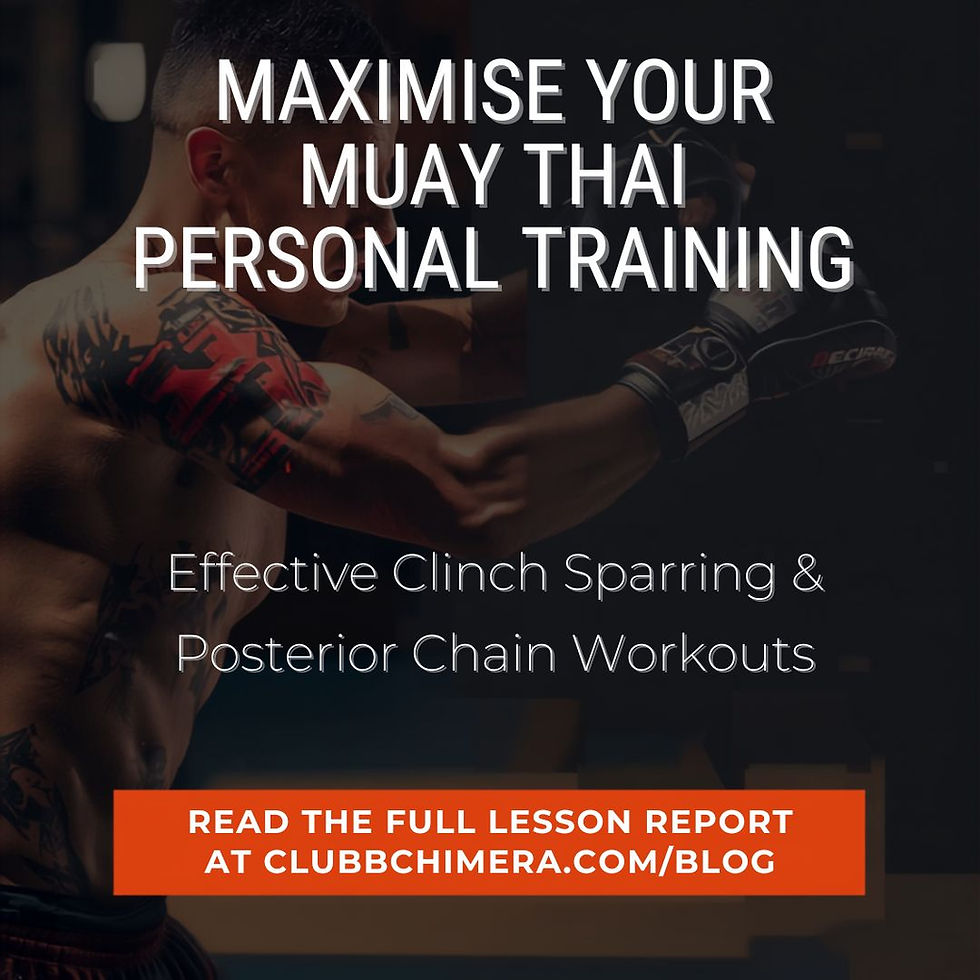
When it comes to improving your Muay Thai skills, focusing on specific techniques and strengthening your body’s key muscle groups can make a huge difference. In my recent muay thai personal training session, we concentrated on clinch sparring combined with targeted posterior chain exercises. This approach not only sharpens your clinch game but also builds the strength and endurance needed to dominate in the ring.
Here’s a detailed breakdown of the session and why combining clinch work with posterior chain training can elevate your Muay Thai performance.
The Importance of Clinch Training in Muay Thai
The clinch is a defining element of Muay Thai, setting it apart from many other striking arts. Mastering the clinch allows you to control your opponent’s posture, deliver powerful knees and elbows, and execute sweeps to off-balance them. However, clinch work requires more than just technique; it demands strength, timing, and endurance.
In our muay thai personal training session, we structured the clinch sparring into progressive rounds to build skill and confidence:
Rounds 1 and 2: Warm-up with teeps and straight punches to get the body moving and the mind focused.
Rounds 3 and 4: One fighter attempts to clinch while the other defends, emphasizing control and defense.
Round 5: Clinch with sweeps only, no strikes, to practice balance and off-balancing techniques.
Round 6: Clinch with elbow strikes and sweeps, adding offensive elements.
Round 7: Clinch with knee strikes and sweeps, focusing on close-range power.
Round 8: Clinch with both elbow and knee strikes plus sweeps, combining all elements.
Rounds 9 and 10: One fighter tries to score from the clinch while the other tries to break free and counterattack.
This progression allows you to build from basic control to full offensive clinch work, improving both your technique and your ability to adapt under pressure.
Why Posterior Chain Strength Matters for Muay Thai
The posterior chain includes muscles along the backside of your body: hamstrings, glutes, lower back, and calves. These muscles are crucial for generating power, maintaining balance, and preventing injuries during intense Muay Thai training and fights.
After the clinch rounds, we moved into a 200-rep superset combining pull-up variations and Nordic curl variations. This workout targets the posterior chain by:
Pull-ups: Strengthen the upper back, shoulders, and arms, which are essential for clinch control and defensive maneuvers.
Nordic Curls: Focus on hamstrings and glutes, improving explosive power for knees, sweeps, and footwork.
This combination builds endurance and strength in the muscles that support your clinch and overall striking ability.
How to Incorporate Clinch Sparring and Posterior Chain Workouts into Your Training
If you want to get the most from your muay thai personal training, consider structuring your sessions like this:
Warm-up with light striking: Use teeps and straight punches to prepare your body and mind.
Progressive clinch sparring: Start with control and defense, then add sweeps and strikes gradually.
Posterior chain superset: Follow clinch work with pull-ups and Nordic curls to build strength and endurance.
Cool down with PNF stretching: Finish with 15 minutes of proprioceptive neuromuscular facilitation (PNF) stretching and muscle releases to improve flexibility and recovery.
This balanced approach ensures you develop both the technical and physical aspects of Muay Thai.
Practical Tips for Effective Clinch Sparring
Focus on control, not just offense: Clinch is about managing your opponent’s posture and movement. Work on maintaining balance and positioning.
Use sweeps to create openings: Sweeps disrupt your opponent’s base, setting up strikes or escapes.
Mix strikes and sweeps: Combining elbows, knees, and sweeps keeps your opponent guessing and increases your scoring chances.
Practice breaking the clinch: Knowing how to escape and counterattack is as important as clinching itself.
Benefits Beyond the Ring
Working on the clinch and posterior chain doesn’t just improve your fight skills. It also:
Enhances your overall body strength and posture.
Reduces the risk of injury by strengthening supporting muscles.
Improves your endurance for longer, more intense training sessions.
Builds mental toughness through controlled sparring and physical challenge.
Final Thoughts on Muay Thai Personal Training
Integrating focused clinch sparring with posterior chain workouts creates a powerful training combination. In my experience, this method builds not only skill but also the physical foundation needed to perform at your best. If you want to take your Muay Thai to the next level, consider adding these elements to your training routine.
Ready to improve your clinch game and build strength that lasts? Book a muay thai personal training session focused on these techniques and feel the difference in your next fight or training session.


Comments