


MMA Coaching Autonomy: Constraints Led Games


MMA Mixed Martial Arts Personal Training
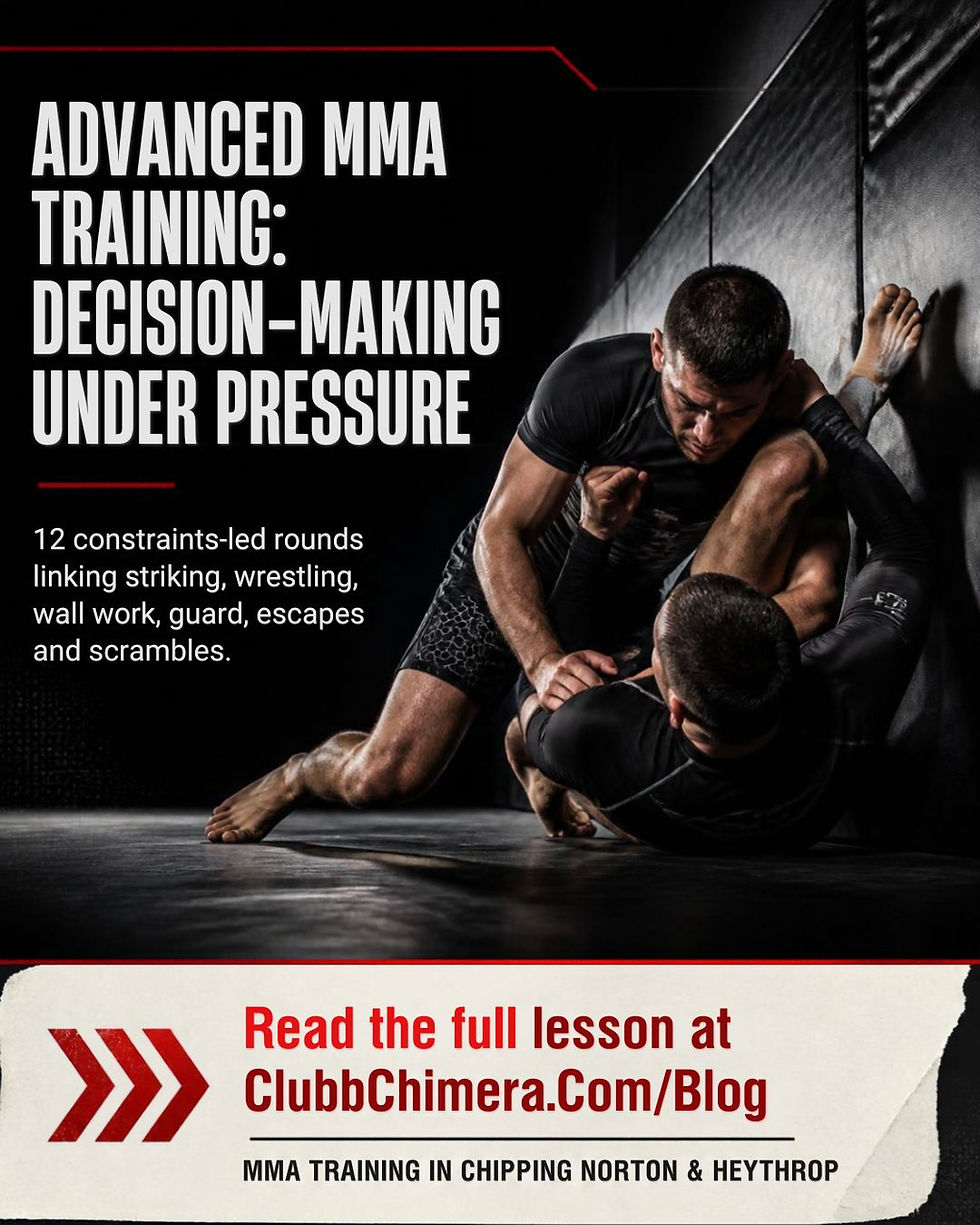
Good coaching should not produce students who wait for permission. It should produce students who can make decisions under pressure.
That principle shaped this session. The work centred on autonomy, constraints-led games, boxing fitness, and mobility. The goal was not to copy a perfect technique in a quiet room. The goal was to help students build ownership of movement while dealing with resistance, space, fatigue, and tactical choices.
In private martial arts lessons, this matters. One-to-one coaching gives space for detail, but it can also tempt the coach to over-instruct. If every answer comes from the coach, the student becomes dependent. If the student is guided towards finding useful answers, the learning sticks.
Autonomy is not a lack of coaching
Autonomy in training does not mean letting students do anything they like. It means giving them a clear problem, a safe structure, and enough room to solve it.
The coach still sets the aim. The coach still watches, corrects, and adjusts. The difference is that the student gets to make meaningful decisions.
A common mistake in combat sports coaching is to start with a fixed technical model.
“Put your hand here.”
“Step there.”
“Finish like this.”
Those details matter, but they only matter when the student understands the problem the technique solves. A takedown is not just a set of steps. It is an answer to distance, timing, posture, balance, fear of strikes, and the opponent’s reaction.
A constraints-led approach changes the order. The coach designs a task that makes the student explore the right behaviour.
For example, if the aim is to improve takedowns against the cage, the coach can limit the space, define the scoring, and control the starting position. The student then learns why head position, foot placement, and grip choice matter. They feel it.
That is a stronger lesson than a speech.
A useful session should ask questions like these:
Can the student recognise the best route without being told?
Can they adapt when the first option fails?
Can they keep their shape under pressure?
Can they explain why they chose one technique over another?
Can they repeat the skill when tired?
The four games below were designed around those questions.
The constraints-led games changed the geography of the fight
The word “geography” matters in mixed martial arts. Space changes everything. A takedown in the centre is not the same as a takedown near the cage. A back control position on the feet is not the same as top control on the ground. A jab used in open space creates different reactions from a jab used to enter into a clinch.
These games used geography as a teaching tool. They did not isolate technique from tactics. They linked movement to position, scoring, and consequence.
Game 1, Cage Top vs Open Back
This game created a clear contest between two valuable positions.
One student worked from a top position against the cage. The other worked to create an open back opportunity, meaning a route to get behind the opponent with space to attack or escape.
The cage top player had a direct job. Keep pressure, deny turns, and use the fence as a barrier. The open back player had to avoid being flattened, create angles, and find a route to the back.
The constraint was simple. The environment made certain choices more useful than others.
Against the cage, the top player does not need to chase as much. The fence does some of the work. That teaches the value of shoulder pressure, hip control, and keeping the opponent’s head facing the wrong way.
The open back player learns a different lesson. They cannot just bridge hard and hope. They must create wedges with knees and elbows, turn at the right moment, and take an angle before the top player shuts the door.
This game rewards patience. It also rewards timing. If the bottom player turns too early, they give up control. If they wait too long, they get pinned.
The coaching focus was not “do this move”. It was “find the route”. That gives the student ownership. They begin to connect the details to the outcome.
Game 2, Cage Takedown vs Centre Takedown
This game compared two takedown worlds.
In the centre, movement is wide open. Both people can circle, sprawl, retreat, and reset. Against the cage, the fence removes escape routes. The attacker can drive, pin, and chain attempts together.
The students explored both areas. The aim was to learn how the same broad goal, taking someone down, changes when the map changes.
In the centre, entries must cover distance without overreaching. Footwork matters. Head position matters. The attacker needs to get past the danger zone where punches can land, then connect to the body or legs.
Against the cage, the attacker can use pressure to reduce the defender’s choices. The defender can no longer retreat in a straight line. They must frame, turn, widen their base, or fight for underhooks, which are inside arm positions used to control the opponent’s upper body.
The centre takedown rewards speed, timing, and clean entry.
The cage takedown rewards pressure, patience, and positional control.
The game also teaches defence. A student learns that defending a takedown in the centre is not the same as defending one with their back near the fence. In the centre, distance can be a defence. Near the cage, posture and hand fighting become urgent.
This is why geography should not be an afterthought. A private lesson that only practises takedowns in open space leaves a gap. Real exchanges move. People get driven to the edge. Strategy must change with location.
Game 3, The Jab-Entry Takedown
The jab is often taught as a punch. In this game, it became an entry tool.
The task was to use the jab to set up a takedown. The punch did not need to land hard. Its job was to draw a reaction, hide footwork, disturb posture, and create timing.
This is where punch layering becomes important. A jab by itself is easy to read if it always comes at the same rhythm. A jab behind a step, a level change, or a head movement becomes harder to solve.
Students worked with layers such as:
A jab to occupy the guard, then a step into clinch range
A jab to make the opponent lean back, then an entry under their centre of balance
A jab with head movement, then a body lock attempt
A jab that forces a parry, then a change of angle
The constraint kept the lesson focused. The takedown had to come from the jab entry. That stopped students from rushing into random wrestling exchanges. It made them examine the link between striking and grappling.
This is a key difference between pure boxing and combat sports that include takedowns. In boxing, a jab sets up punches, angles, and defensive exits. In MMA, the jab can also set up a clinch or a level change. The stance, distance, and recovery must take that into account.
The best lesson from this game was that a strike can be a question. The opponent’s answer tells the attacker what comes next.
If the opponent shells up, clinch.
If they lean back, step deep.
If they parry hard, go around the arm.
If they step away, cut the angle before entering.
That is autonomy in action. The student does not memorise a single sequence. They learn to read the response.
Game 4, Standing Back vs Ground Top
This game linked back control on the feet with top control on the floor.
The starting point was standing back control, where one student had position behind the other. The opponent’s aim was to avoid being taken down or controlled. The attacker’s aim was to decide whether to stay standing, drag the opponent down, or transition to top control.
The ground top position was not treated as an automatic win. The attacker had to land in a useful position. If the takedown gave the opponent space to scramble, the control was not good enough.
This game teaches a hard truth. Getting behind someone is valuable, but poor choices from there can waste the advantage.
The attacker had to manage:
Chest connection
Hip position
Hand control
Foot placement
Safe trips or mat returns
The opponent’s turning escape
The defender had to manage posture, hand fighting, and the direction of their turn. They also had to avoid giving up worse positions in a panic.
The game joined two phases that often get taught separately. Standing control and ground control are not separate worlds. One feeds the other. If the transition is weak, the opponent escapes between them.
That gap is where many students lose good positions.
Boxing fitness belongs inside skill work
Fitness work should not be random punishment. It should support the skills being trained.
Boxing fitness fits well into this type of coaching because it develops footwork, head movement, rhythm, and punch layering. It also tests whether a student can keep their structure when breathing hard.
The session used boxing rounds that were not just about throwing more punches. The work had a purpose.
Footwork came first. Students had to step without crossing their feet, move after punching, and keep enough balance to defend or enter. This links directly to the jab-entry takedown game. A student who throws a jab and falls forward cannot wrestle safely from it. A student who punches and keeps their feet under them has options.
Head movement came next. Slips, rolls, and small changes of level were used to reduce predictable entries. The point was not dramatic movement. Big movement can create openings for the opponent. The focus was small, efficient changes that keep the student able to strike, clinch, or exit.
Punch layering tied it together. Rather than throwing isolated punches, students built combinations with a purpose.
A simple example:
Jab to test the guard.
Jab again with a step.
Add a cross if the line opens.
Change level if the opponent lifts their hands.
Exit on an angle or enter the clinch.
This is not only conditioning. It teaches decision-making under fatigue. That matters more than a round of unfocused effort.
The fitness benefit is real. Repeated rounds of footwork, head movement, punching, and controlled entries challenge the heart, lungs, legs, shoulders, and trunk. But the better benefit is technical endurance. The student learns to keep making good choices when tired.
That is where Personal Training and martial arts coaching can meet well. General conditioning helps. Specific conditioning helps more when it matches the demands of the skill.
Strategy comes from manipulating space and choices
The four games shared one theme. They changed the student’s choices by changing the conditions.
That is the heart of constraints-led coaching.
A constraint can be the area, the starting position, the scoring rule, the time limit, or the allowed techniques. Used well, it guides behaviour without turning the session into a lecture.
Here is how the games altered strategy:
Game | Main geography | Main strategic lesson |
Cage Top vs Open Back | Fence and ground | Pressure can pin, angles can free |
Cage Takedown vs Centre Takedown | Edge versus open space | Takedowns change when retreat is removed |
The Jab-Entry Takedown | Striking range into clinch range | Punches can create grappling entries |
Standing Back vs Ground Top | Feet to floor | Transitions must preserve control |
This approach also reveals the student’s habits.
Some rush takedowns from too far away. Some freeze against the cage. Some strike well but fail to connect punches to entries. Some get behind an opponent and then lose control during the takedown.
A private session can address these habits quickly because the coach can adjust the game. If the student is too passive, the scoring can reward initiative. If they rush, the game can punish poor balance. If they rely on strength, the task can require control before points count.
The aim is not to make training easy. The aim is to make the lesson clear.
Mobility is the base that keeps training honest
Mobility work often gets treated as the quiet part at the end. That is a mistake.
Good mobility supports striking, clinching, takedowns, ground transitions, and recovery positions. Poor mobility forces compensations. Those compensations can make technique weaker and training less comfortable.
A comprehensive session should include mobility for the areas that take the most load:
Ankles for stance, footwork, and level changes
Hips for takedowns, guard work, and scrambling
Spine for rotation, posture, and safe turning
Shoulders for framing, punching, and hand fighting
Neck and upper back for clinch positions and defensive posture
This does not need to be complicated. Controlled joint circles, deep squat positions, lunges with rotation, hip switches, shoulder rotations, and slow transitional floor work all have value. The key is intent. Mobility should prepare the body for the positions it will meet in training.
It also gives the coach useful information. If a student cannot comfortably level change, their takedown entry may need adjustment. If they cannot rotate through the upper back, their punching mechanics may suffer. If their hips lock up on the floor, their escapes may rely too much on strength.
Mobility is not separate from fighting skill. It gives the body more honest options.
For more on this approach to coaching, visit Clubb Chimera’s MMA training page.
The main lesson from this session was simple. Students learn best when they solve real problems in a structured way. Constraints-led games create those problems. Boxing fitness adds pressure and rhythm. Mobility keeps the body ready to move well.
A good coach does not just hand over techniques. A good coach builds better decision-makers.


Comments