


No-Gi Submission Grappling Partner Training


No-Gi Submission Grappling Partner Training: Analysing a Closed Guard Sequence
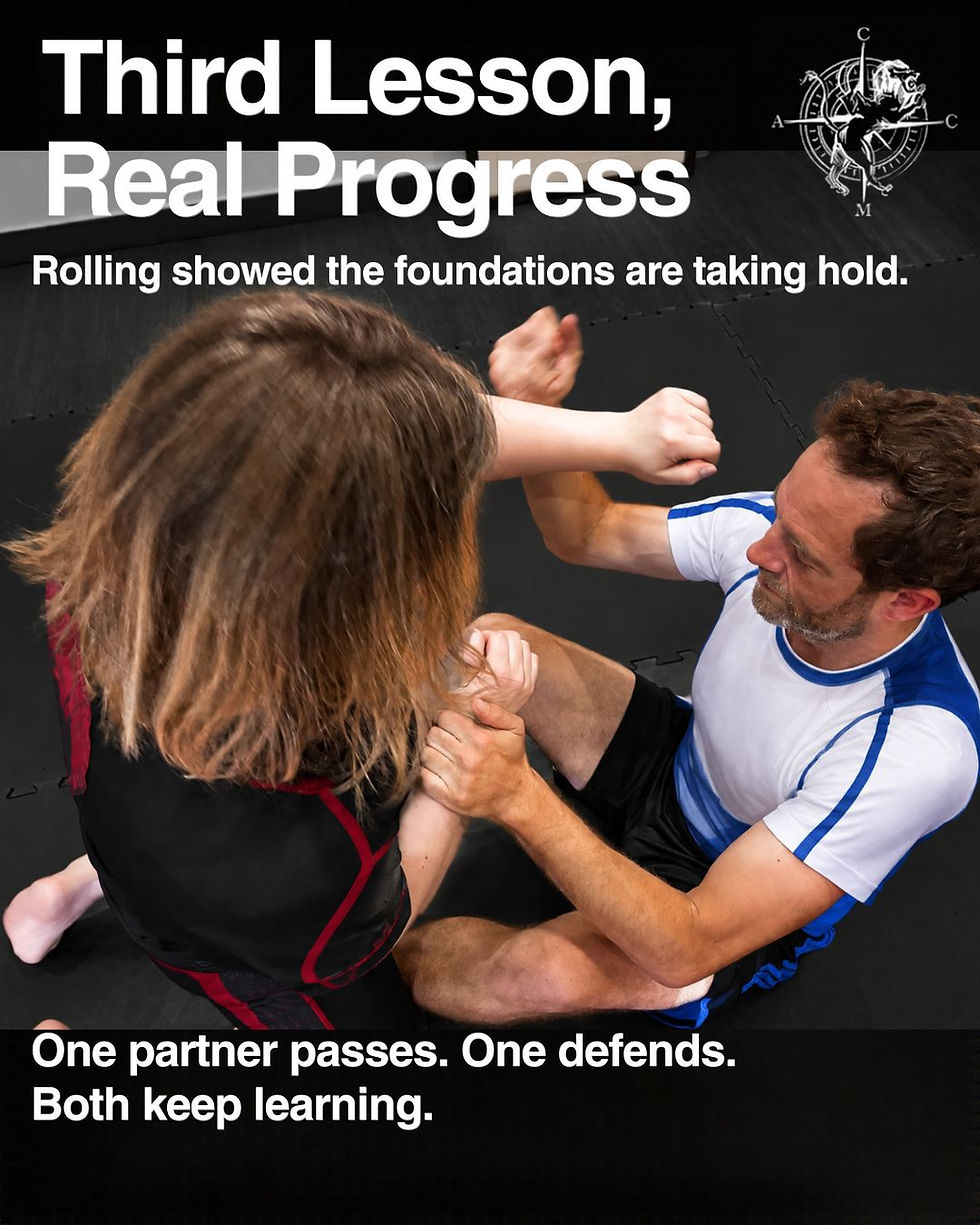
Hour four of our recent Submission Grappling course took an unexpected but highly valuable tactical turn. In our previous session, we had established a clear developmental focus: one partner would work on passing the guard, while the other focused on attacking and defending from the bottom.
However, real-world training requires adaptability. With one partner managing a minor shoulder injury sustained outside of class, we adjusted our approach. We lowered the physical intensity, moving away from our usual high-intensity constraints-led sparring. Instead, we utilized this session for focused no-gi submission grappling partner training, exploring an intricate sequence of attacks, counters, and re-counters—essentially mapping out a technical synopsis of a high-level ground fight.
Because both practitioners have already successfully executed these techniques against live resistance, stepping back into a non-resistance flow did not hinder their progress. Instead, treating the mat like a chess board opened up fresh strategic insights and perfectly laid the groundwork for our next live training block.
A Case Study in Technical No-Gi Submission Grappling Partner Training
This breakdown outlines the dynamic sequence between the top passer and the bottom guard player, tracking how every offensive movement triggers a highly calculated defensive response.
[1. Top Postures Up] ──> [2. Bottom: Hip-Bump Sweep]
│
▼
[3. Top: Combat Base Pin] ──> [4. Bottom: Flower Sweep]
│
▼
[5. Top: Underhook Pass] ──> [6. Bottom: Scissor Sweep]
│
▼
[7. Top: Needle-and-Thread] ──> [8. Bottom: Shoulder Kick Setup]
│
▼
[Omoplata / Reverse Armbar / Triangle]
Phase 1: The Hip-Bump Setup & Combat Base Counter
• Top Player's Initial Action: The top player postures up vertically to hide their elbows. This defensive posture effectively prevents the bottom player from isolating an arm for a Kimura submission.
• Bottom Player's Counter: Recognizing that the top player has postured up high, the bottom player exploits the newly created space. They open their closed guard, sit up aggressively, and launch a Hip-Bump Sweep.
• Top Player's Re-counter: The top player blocks the bottom player’s hips to kill the sweeping momentum and immediately transitions into a combat base (one knee up, one knee down). By using the elevated knee, they pin the bottom player's inside leg to the mat, preparing to slice through the guard.
Phase 2: The Flower Sweep Interception & Underhook Pass
• Bottom Player's Counter: As the top player reaches to frame and block the hips, the bottom player grips the blocking sleeve, traps the leg on that same side, and shifts their hip angle to launch a Flower (Pendulum) Sweep.
• Top Player's Re-counter: The top player neutralizes the sweep by dropping their center of gravity and kneeling. They trap the bottom player's sweeping hand, use their own hip and torso weight to pin the inside leg, and secure an underhook on the opposite leg to begin a heavy guard pass.
Phase 3: The Scissor Sweep vs. The Needle-and-Thread Pass
• Bottom Player's Counter: As the top player drops their weight to heavy the hips, the bottom player quickly inserts a knee shield across the chest, aligns their bottom leg flat along the mat, and extends their hips to execute a classic Scissor Sweep.
• Top Player's Re-counter: Rather than conceding the sweep, the top player beats the scissor frame by executing a precise Needle-and-Thread pass. They weave their arm directly under the bottom player's top leg, pinning the lower leg to slice cleanly through the guard.
Phase 4: The Late-Stage Submission Chain
• Bottom Player's Final Counter: As the top player drives forward to commit to the needle-and-thread pass, the bottom player abandons the sweep entirely and kicks their top leg completely over the top player’s near shoulder.
• The Technical Finish: Depending on how the top player reacts to the shoulder control, the bottom player can seamlessly chain three high-percentage attacks:
The Omoplata: If the top player drives forward, the bottom player rotates their hips to trap and isolate the shoulder joint.
The Reverse Armbar: Available if the top player's arm remains straight and trapped tightly against the hip.
The Triangle Choke: If the top player attempts to pull their head back to escape, the bottom player switches their hip angle, shoots the leg over the back of the neck, and locks in the submission.
Key Takeaways for Technical Partner Training
This session beautifully illustrated how a minor injury doesn't mean a missed training day. By lowering the physical friction, our clients were able to analyze the macro-structure of grappling sequencing. When partners share a deep familiarity with each other's movement patterns, this analytical "flow-drilling" builds incredible spatial awareness and sharper reflexes for when the intensity ramps back up.


Comments