


Round Kicks in Muay Thai Personal Training Intensive Course

22.12.2025
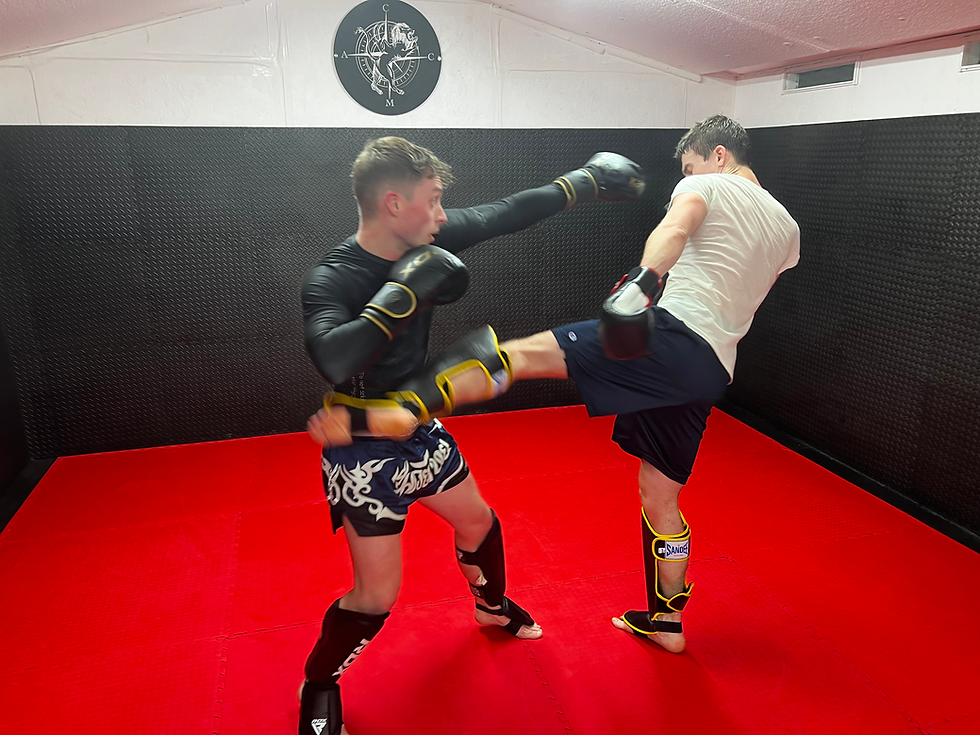
Muay Thai Personal Training - Intensive Course Re-Cap
This is the second session of a series of four 2-hour lessons (an intensive Muay Thai Personal Training course) for my client from the United States. He has scheduled an intensive course with me during the holiday period from December 21st to 24th. Yesterday, we focused on teeps. Today, a long-term client joined us to assist in developing round kicks.
We began with a warm-up that included dynamic stretching and muscle activation, combined with light shadow work. Subsequently, my two clients engaged in specific sparring exercises.
The training involved the following rounds:
Warm-up Round
The initial round emphasized flow and targeting.
Exchange targeting low round kicks
Correcting Defence
I observed that my client tended to look down when preparing to kick, so I addressed this issue over the next two rounds.
Single punch counters to low round kicks
Low round kicks versus single punches
The K-Block/Dutch Block
Given that kick-catching is allowed in Muay Thai, it is essential to execute round kicks to the body and head without getting caught. We explored the fundamental concept of the K-block, which was new to him, and then applied it in these sparring rounds.
Kick-catching versus round kicks
Round kicks versus kick-catching
Weapons Against Round Kicks
These rounds involved deploying the most effective techniques against round kicks, encouraging my client to discover methods to counter them with round kicks.
Teeps versus round kicks
Round kicks versus teeps
Punching versus kicks
Kicks versus punches
The lesson finished with some partner stretching. Partner stretching needs to be handled in a responsible manner. If done incorrectly it can be injurious or not very functional. I am keen that my clients not only get an opportunity to flush out their lactic acid, reduce DOMS (Delayed Onset of Muscular Soreness) and increase their flexibility, but that they retain strength and control in their increased range of movement. This is why I taught them how to use PNF, or Proprioceptive Neuromuscular Facilitation, stretching with isometrics along with balancing as they warmed down.

Comments