


Scarf Hold Defence to Arm-Bar in Martial Arts Online Training


Martial Arts Online Training
The scarf hold can feel like a dead end when the top player settles their weight, clamps the head, and turns the bottom player’s shoulders away from freedom. That is why it is such a useful position to study. It reveals what a student really understands about hips, frames, pressure, timing, and patience.
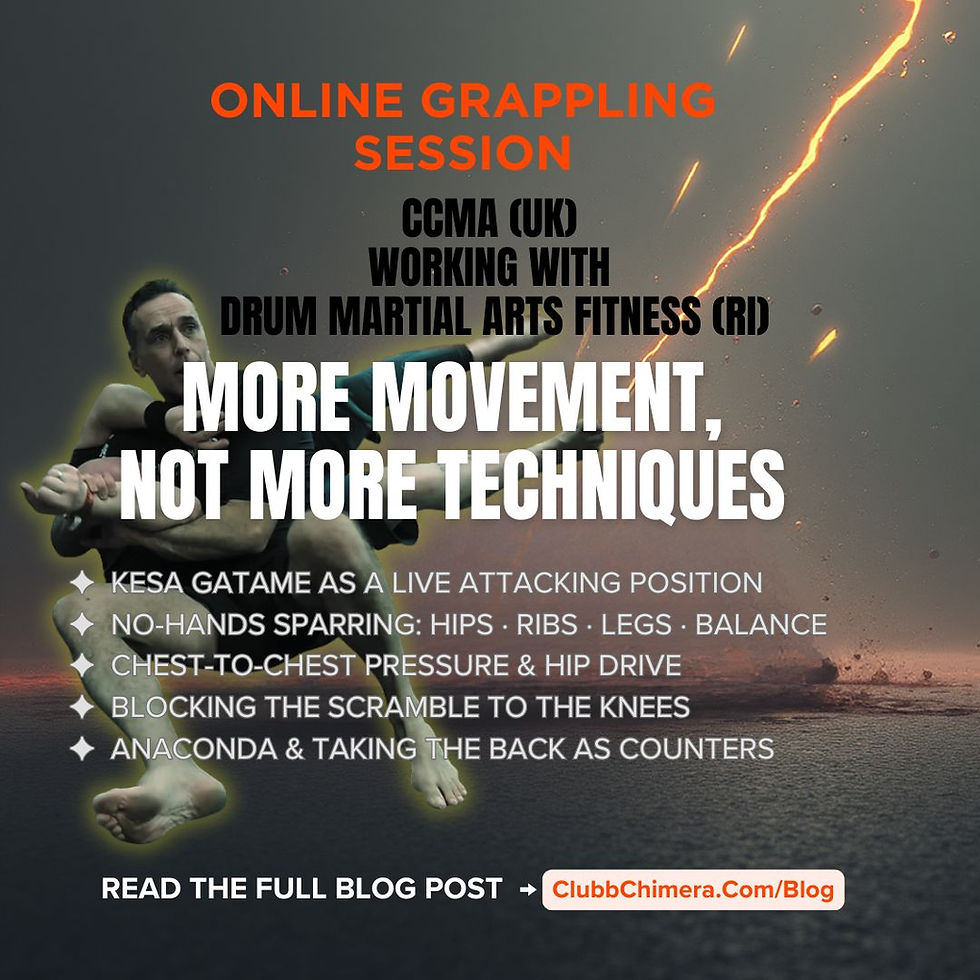
In the second hour of an online martial arts training course with a teacher from Drum Martial Arts and Fitness in the Republic of Ireland and his son, the lesson returned to the scarf hold. The son is preparing for an upcoming grading, with a focus on ground-fighting. The previous lesson explored attacking and defending from the position. This session shifted more clearly towards defence, especially the hip escape onto the back and the transition into an arm bar.
The most useful part of the session was not a new technique. It was the way the student’s body exposed the problem. When both father and son sparred from scarf hold without using their hands actively, the movement became honest. Without the hands grabbing, pushing, and masking weak spots, the hips had to do the work. That revealed weaknesses in glute and hip activation, which are often the hidden reason a scarf-hold escape fails.
Good ground-fighting is not just a set of moves. It is a set of problems solved under pressure.
The scarf hold tests whether the hips can work under pressure
Scarf hold, often known in judo and grappling circles as kesa gatame, is a powerful control position. The top player sits across the torso, controls the head and arm, and uses their body angle to pin the bottom player’s shoulders. If the bottom player stays flat, the top player can apply pressure, attack the near arm, switch to other pins, or simply hold position.
A common beginner response is to push with the arms. That can work for a moment against an unskilled partner, but it often makes the position worse. Pushing with straight arms can expose submissions. It can also give the top player better connection. Even when it creates space, the bottom player may not know how to use that space with the hips.
That is why removing the hands from active use is such a valuable constraint.
When the hands are taken out of the main exchange, the student must ask better physical questions:
Can I turn onto my side without pushing?
Can I bridge from my feet rather than wriggling from my shoulders?
Can I activate the glutes enough to shift the opponent’s weight?
Can I move my hips away, then bring them back in to attack?
Can I keep breathing while under pressure?
The lesson exposed the key issue clearly. The student could understand the escape in outline, but the lower body was not always arriving at the right time. The hips would move, but the shoulders might lag behind. The grip could appear, but the body had not rotated far enough to make the arm bar available. The counter existed, but the body was not yet organised enough to take it.
That is a coaching win. Once the real problem appears, practice can become much more precise.
The hip escape onto the back creates the counter-attack
The defensive pathway we worked on began with escaping the hips and turning towards the opponent’s back. This matters because a scarf-hold escape should not only be about getting out. A strong escape can lead straight into a counter-attack.
The broad sequence looked like this:
Create enough hip movement to stop being pinned flat.
Turn towards the opponent’s back.
Hook the opponent’s top leg with the near leg.
Use that hook to stay connected and limit the opponent’s movement.
Underhook the arm.
Establish a kimura-style grip.
Rotate the body while controlling the arm.
Finish the arm bar if the position allows it.
The phrase “escape the hips” can be misleading if treated as a single movement. In practice, the hips must move out and then back in.
The first movement creates space. The second movement uses that space to attach, climb, and attack.
If the student only moves away, the top player may follow, reset pressure, or simply turn back into a more stable pin. If the student only tries to move in without first making room, they stay jammed underneath. The rhythm is the point: hips out to unpin the body, hips in to counter-attack.
This is where glute and hip activation matters. A passive bridge lifts the body but does not direct it. A strong bridge connected to hip escape changes the angle. A small, well-timed hip shift can do more than a large, panicked shove.
The aim is not to bench press the opponent away. The aim is to change the line of pressure, make the top player adjust, and take advantage of the moment when their control weakens.
A constraints-led game makes the escape more honest
Rather than drilling the full technique from start to finish with full cooperation, I began formulating a constraints-led game. This approach breaks the larger skill into small live battles. Each round gives one player a clear objective and gives the other player a clear way to resist.
That structure keeps the practice alive without making it chaotic. The student does not simply repeat a shape. They learn to solve the problem against a partner who is actively trying to deny the next step.
The game developed across four rounds.
Round 1 focuses on the hip escape and leg hook
The bottom player’s task is to escape the hips and hook the top leg on the opponent’s top leg. The top player’s task is to stop that hook from being established.
This round teaches the student that the leg hook is earned by angle, not by reaching. If the hips have not moved enough, the leg will stretch, scrape, or miss. If the student turns too late, the top player can follow and flatten them again. If the glutes do not fire, the hips do not clear.
The hook also gives immediate feedback. Either the student has connected to the leg or they have not. That makes it easier to coach than a vague instruction such as “move more”.
The bottom player should feel the difference between a desperate leg reach and a connected hook that follows the hip escape. The first feels weak. The second starts to turn the position.
Round 2 focuses on the underhook
Once the leg hook becomes more reliable, the next battle is the underhook. The bottom player tries to underhook the arm. The top player tries to prevent that underhook from being established.
This round adds upper-body timing without letting the hands take over the whole exchange.
The underhook should not be a separate event from the hip movement. It should appear because the body angle has improved. When the student rotates properly, the underhook becomes accessible. When they stay flat, they have to reach, and reaching under pressure usually fails.
For grading preparation, this is important. A student may be able to demonstrate a clean underhook with a compliant partner, but grading pressure often reveals whether the movement survives resistance. The constraint helps build that bridge between demonstration and application.
Round 3 focuses on the kimura grip
The next round asks the bottom player to establish a kimura grip on the arm while the top player prevents it.
This is where the main technical challenge appeared.
The student could seek the grip, but the body rotation did not always happen at the same time. The hands were trying to win before the torso had turned. That creates two problems. The grip becomes weaker, and the arm bar becomes harder to line up.
The kimura grip in this context is not the finish. It is a steering wheel. It controls the opponent’s arm so the body can rotate into the correct attacking angle. If the student treats it only as a hand position, they miss the larger purpose.
A useful coaching cue here is:
The grip does not drag the body into place. The body turns as the grip is made.
This lesson point matters. Many students learn grips as fixed shapes. They see the hands connect and assume the job is done. In live ground-fighting, a grip that is not connected to hip movement and body rotation is often fragile.
The student needs to feel the grip and rotation as one action.
Round 4 focuses on completing the arm bar
The final round puts the pieces together. The bottom player tries to complete the arm bar. The top player tries to escape.
This round should not start too fast. If the earlier rounds are still unreliable, the final round becomes a scramble. Speed hides the missing details for a while, then fails under stronger resistance.
The finish depends on several linked details:
The hips have escaped enough to create angle.
The leg hook has limited the opponent’s ability to turn away.
The underhook has opened the path to the arm.
The kimura grip has controlled the limb.
The body has rotated at the same time as the grip forms.
The hips return in to close distance and finish the attack.
The most important detail for this student is the body rotation. Without it, the arm bar becomes a tugging action. With it, the whole body supports the submission.
That is the difference between knowing the move and owning the movement.
Coaching the body to rotate with the grip
The key challenge from the session was not the idea of the arm bar. It was coordinating rotation while establishing the kimura grip. That is a common point of failure because students often organise techniques in parts:
Escape.
Hook.
Underhook.
Grip.
Turn.
Arm bar.
That list is useful for teaching, but the body cannot perform it as six separate pauses under pressure. The steps need to begin merging.
The grip and turn are the main merge point here.
One way to coach this is to reduce the finish and spend more time on the transition. The student does not need to complete the arm bar every repetition. For a block of practice, the success criteria can be much smaller:
Has the student escaped the hips?
Has the student attached the leg hook?
Has the student made the kimura grip while turning?
Has the student ended on the correct angle?
That keeps the focus on the real problem. If every repetition rushes to the finish, the student may keep reinforcing the faulty habit of gripping first and rotating late.
Another useful coaching method is to slow the resistance down without removing it. The top player gives steady pressure and tries to block the grip, but does not explode out at full speed. This lets the student feel the timing gap. Once the timing improves, resistance can rise.
The father’s role as training partner is valuable here. Because he is also learning, he can feel when the son’s escape becomes stronger. He can report whether the hook disrupts his base, whether the underhook starts to appear naturally, and whether the kimura grip begins to control the arm rather than merely hold it.
That feedback loop is one reason a teaching consultation can be so useful for instructors and parents supporting a student at home. The coach can shape the task, the partner can provide realistic pressure, and the student gets a clearer route from technical knowledge to live use.
Why this matters for grading preparation
Grading is not only about remembering techniques. It is about showing control, posture, awareness, and the ability to apply principles under pressure. In ground-fighting, scarf hold defence is a strong test because it combines all of those qualities.
A student defending scarf hold must manage discomfort. They must avoid panic. They must use the hips before the hands. They must create angle instead of pushing straight into strength. If they counter-attack, they must also show that the escape did not end in a loose scramble.
The arm bar from this escape gives the student a complete story:
They start in a bad position.
They improve the angle.
They attach to the opponent.
They control the arm.
They rotate into an attack.
They finish with structure rather than force.
That is exactly the kind of progression that shows understanding.
The no-hands sparring constraint from scarf hold also remains a useful warm-up or diagnostic game. It can be used for short rounds before more technical drilling. If the hips are sleepy, the student will feel it quickly. If the glutes engage and the hips begin to move with purpose, the rest of the technique becomes more available.
For younger students, this also keeps the lesson playful. They are not just being told to “bridge harder” or “turn more”. They are trying to win a small, clear problem. Can the hook be secured? Can the underhook be won? Can the grip be made before the defender gets flattened?
Small games make big skills easier to build.
The takeaway from the second hour
The second hour moved the student closer to a functional scarf-hold defence by narrowing the focus. The lesson did not try to cover every possible escape or submission. It stayed with one pathway and made the hidden weaknesses visible.
The main lesson was simple: the hips must escape first, then return with purpose. The leg hook, underhook, kimura grip, and arm bar all depend on that movement. If the hips stay trapped, the hands will overwork. If the body fails to rotate with the kimura grip, the arm bar will feel forced.
The next step is to keep the constraints-led rounds in the training cycle and increase resistance only when each layer becomes reliable. The goal is not a pretty arm bar against a compliant partner. The goal is a student who can feel pressure, move the hips, create angle, and counter-attack with control.


Comments