


Advanced High Kick Training on the Heavy Bag with the Question Mark Kick


The last private lesson of the evening is often where the most technical work happens. The room is quieter, the pace is more focused, and there is time to slow a movement down before putting power back into it.
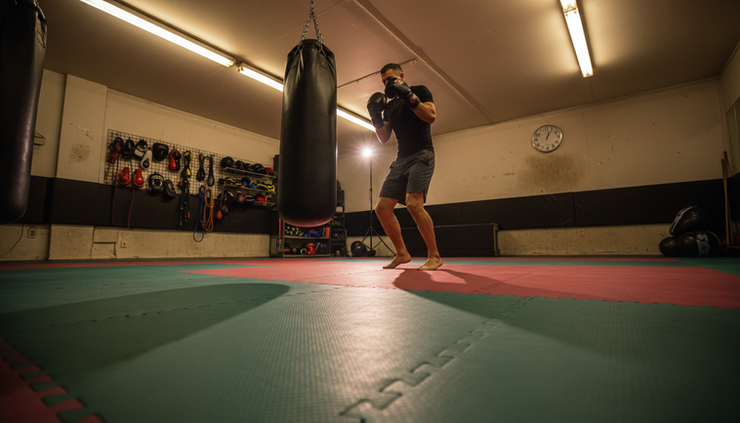
This session was a 1.5-hour regular private lesson with a client beginning another 10-lesson block. The goal for this new block is advanced training methods, not just more combinations or harder rounds. Tonight’s focus was clear: build better high kicks for Muay Thai, kickboxing and MMA, then use that work to develop the question mark kick.
Everything took place on the heavy bag. No pads, no partner sparring, no distractions. Just body mechanics, timing, impact, correction and repeatable drills.

Why the heavy bag is ideal for advanced high kick work
High kicks can look sharp in the air and fall apart on impact. The heavy bag removes that illusion quickly.
A good high kick needs more than flexibility. It needs:
A stable support leg
Clean hip rotation
A knee path that hides the final target
A reliable guard during the kick
Strong recovery after impact
Enough balance to kick again or defend
The bag tests all of that. It gives resistance, but it does not help. It does not move like a pad holder. It does not meet the kick halfway. If the angle is wrong, the shin slides. If the distance is wrong, the foot slaps or the knee jams. If the base is weak, the kicker gets pulled out of stance.
That made it perfect for this session.
The early rounds were not about throwing harder. They were about improving the structure of the high kick so the later question mark kick had a stronger foundation. In advanced striking, the spectacular technique is usually built from something simple done very well.
Better high kicks came first. The question mark kick came later.
Building the high kick before adding deception
The high kick had to be treated as its own skill before using it as part of a feint or layered attack. We worked through the kick in sections, then put it back together under pressure from the bag.
The first correction was the support foot.
Many fighters can kick high because they are flexible, but they still restrict their own hip by leaving the support foot too square. That limits rotation and forces the kicker to lean back excessively. On the bag, this often shows up as a slap with the foot rather than a clean shin connection.
The support foot needed to turn enough to open the hip. Not an exaggerated spin, just a decisive pivot that let the kicking hip come through.
The second focus was posture.
A high kick does not mean throwing the head backwards and hoping the leg reaches. The upper body can lean slightly, but the fighter still needs structure. If the spine collapses, the kick loses power and the recovery becomes slow. For Muay Thai, kickboxing and MMA, that recovery matters. A missed high kick can turn into a clinch entry, a counter cross, a body lock or a takedown attempt.
The third focus was the return.
A lot of heavy bag kicking drills reward impact but ignore what happens next. In fighting, the kick is not finished when it lands. It is finished when the kicker is back in stance and ready to attack or defend.
So the high kick drill became simple:
Set the stance.
Pivot the support foot.
Drive the knee up and across.
Turn the hip over.
Land with the shin.
Recoil cleanly.
Return to stance without drifting.
That last point was important. Drifting after the kick can become a habit. The bag makes it tempting because the impact feels satisfying, but advanced training has to include the exit.
A high kick is only as good as the position it leaves behind.
Turning a better high kick into a question mark kick
Once the high kick mechanics were cleaner, we moved into the question mark kick.
The question mark kick works because the early part of the kick suggests one target and the finish hits another. The usual pattern is to show the line of a front kick or teep towards the body, then whip the leg around to the head. The movement draws a curved path, which is where the name comes from.
This was the key coaching point: the question mark kick should not be a lazy high kick with a strange route. It should threaten the middle line first.
If the first phase is not convincing, the defender has no reason to react low or central. If the second phase is too slow, the defender sees the head kick coming. The kick needs both parts.
For this private lesson, the heavy bag gave us a controlled way to train that change of line.
We started with a clear chamber:
Knee lifts straight towards the bag
Toes and knee suggest a front kick line
Hips stay loaded rather than opening too early
The guard stays high
The support foot prepares to pivot
Then came the change:
The support foot turns
The hip opens
The knee cuts across
The lower leg whips around the outside
The shin or instep lands high on the bag
In a fight, the target might be the head, neck or guard line depending on rules and range. On the heavy bag, the goal was not to pretend the bag had a perfect chin. The goal was to train a believable low-to-high path with balance and repeatable impact.
This is where a good Question mark kick tutorial, Advanced Muay Thai heavy bag workout, How to improve kickboxing high kicks approach should slow down. The dramatic part of the kick is the finish, but the useful part is the setup. The defender reacts to the first message they receive. If that message is weak, the kick becomes easy to read.
The main technical details that made the kick sharper
The question mark kick often fails because the fighter rushes to the final shape. They try to draw the curved path too early. That can turn the kick into a wide, looping head kick with less deception and less power.
During the lesson, four details made the biggest difference.
The knee had to sell the first target
The knee line matters. If the knee immediately flares out to the side, the kick looks like a roundhouse from the start. That gives the game away.
The first lift had to look like a front kick or body kick threat. On the bag, that meant the knee travelled forward before the hip opened. The movement did not need to be huge. It just had to be honest enough to create the illusion.
The pivot could not arrive too late
Some fighters delay the support-foot pivot because they are trying to hide the kick. That often makes the final turn weak.
The pivot has to happen at the right moment. Too early, and the kick becomes obvious. Too late, and the hip cannot turn over. We trained this by pausing at the chamber, checking the line, then adding the pivot and finish.
At first, this pauses the rhythm. After enough repetitions, the pause disappears and the timing becomes smoother.
The guard had to stay disciplined
High kicks create a common bad habit: the arms swing down to help the leg rise. On the bag, that might feel powerful. Against a good opponent, it opens the head.
For this session, the opposite hand stayed tight. The same-side arm could counterbalance, but not in a way that exposed the jaw. This is especially important for MMA high kick training, where a caught kick or missed kick can lead straight into a takedown exchange.
The recovery had to be trained every time
The question mark kick can leave the kicker square if the leg drops lazily after impact. We drilled the return as part of the strike, not as an afterthought.
After contact, the leg came back to stance or stepped down with purpose. Both options have value. Returning to stance keeps the fighter safer. Stepping down can set up follow-up punches, knees or angle changes.
The key was intent. No falling out of the kick.
Heavy bag drills from the session
The session moved from isolated mechanics to more demanding rounds. These drills work well for advanced martial arts striking because they keep the focus on quality while still building fight-relevant rhythm.
Single high kick reset rounds
This drill built the base.
The client threw one high kick, recovered fully, then reset. No combination. No rushed second strike. The goal was to make each kick technically clean.
The emphasis was on:
Shin contact
Hip rotation
Guard position
Balance after impact
Returning to stance
This can feel slow, but it reveals details that faster rounds hide.
Low line to high line switching
Next, we alternated between body-height kicks and high kicks. The bag became a simple target map.
The fighter had to change height without changing posture too much. If the high kick required a dramatic lean or wind-up, it stood out. The better version kept the same early rhythm, then changed the final angle.
This drill prepared the question mark kick because it trained the body to move between levels without telegraphing.
Chamber and finish repetitions
For the question mark kick, we separated the chamber from the finish.
The first part was the fake front-kick line. The second part was the whip to the high line. Training it in two pieces made it easier to correct the path.
The drill looked like this:
Lift the knee on the centre line.
Hold the chamber for a brief moment.
Pivot and turn the hip.
Whip the kick high.
Recoil and reset.
Once the mechanics improved, we removed the pause.
Jab to question mark kick
A question mark kick rarely needs to appear from nothing. A simple jab can occupy the guard and hide the first lift of the knee.
We used the jab to set distance and rhythm, then the rear leg question mark kick came behind it. The jab did not need to be heavy. It needed to be believable.
This also helped stop the kick becoming too theatrical. A strike before the kick gave it a practical place inside a combination.
Body kick threat to question mark kick
The final layer used the idea of repeated body attacks.
After a few body-height round kicks or front-kick threats, the question mark kick has a clearer purpose. It punishes the opponent for reading low or middle. On the heavy bag, this means building rounds where the same first movement can finish in different places.
That is where private martial arts coaching tips become useful. The coach can spot whether the first half of each kick really matches. If the setup kick and the question mark kick look different from the start, the deception will not hold up.
Common mistakes when training the question mark kick on the bag
The heavy bag is honest, but it can also reward the wrong things if the drill is careless. A fighter can smash the bag and still build bad habits.
The first mistake is chasing height before control. A head-height kick with poor balance is not advanced. It is risky. The kick should rise as the mechanics allow, not at the cost of stance and vision.
The second mistake is letting the bag swing too much. Some movement is normal, but if every kick sends the bag flying, the drill can turn into chasing. For technical rounds, the kicker should control range and let the bag settle enough to give useful feedback.
The third mistake is making the question mark kick too wide. A big looping arc may land on a static bag, but it gives an opponent time to see it. The better version is tighter. It lifts, redirects and snaps.
The fourth mistake is forgetting the hands. A high-level kick with low hands is not high-level striking. The bag will not counter, so the coach or athlete has to enforce that standard.
The fifth mistake is only training the favourite side. Most fighters have one side that feels natural. Advanced training should still include both, even if one side remains the main weapon. The weaker side often teaches better mechanics because it cannot rely on habit.
How this fits into a 10-lesson advanced block
One session can sharpen a technique, but a 10-lesson block can build a method.
This first session set a useful direction for the block. The question mark kick was not treated as a trick. It became a way to study advanced kicking mechanics, deception, line changes and recovery.
Future sessions can build from this work in several ways:
Add defensive reactions after the kick
Link the kick to boxing entries
Use southpaw and orthodox variations
Add clinch or takedown awareness for MMA
Build timed rounds with specific tactical goals
Move from heavy bag work to pad work and controlled partner drills
The heavy bag remains a strong base because it gives volume. A fighter can repeat the same movement many times without relying on a partner’s timing or pad position. That volume matters, but only if the repetitions stay honest.
For students training around Chipping Norton, Heythrop and the surrounding area, this kind of private session offers the space to correct small details that often get missed in a busy class. The difference between a decent high kick and a dangerous one is rarely one grand change. It is usually a series of small corrections made consistently.
The main takeaway from the session
The question mark kick works best when the basic high kick is already strong. Without balance, hip rotation and recovery, the deception has nothing solid behind it.
Tonight’s heavy bag session showed the value of slowing advanced training down. We built the high kick first, tightened the mechanics, then added the question mark path. Once the first half of the kick became believable and the finish became cleaner, the technique started to look less like a trick and more like a real striking option.
The heavy bag cannot think, defend or counter, but it can tell the truth about structure. If the kick lands well, recovers well and can be repeated without falling apart, it is moving in the right direction.
For advanced kickboxing, Muay Thai and MMA striking, that is the standard worth chasing: clean mechanics, believable setup, sharp impact and a position that is ready for whatever comes next.


Comments