


Constraints Led Karate Sparring for Elbow Strikes and Grip Fighting (Martial Arts Cross-Training)


Martial Arts Cross-Training
This morning, a client from Cotswold Karate School finished his latest block of lessons with me. We recorded the work from our last two sessions, partly as a training record and partly because the material had become too useful to leave as “just another class”.
For the past six months or so, he’s been taking short courses with me on martial arts cross-training, mainly using Muay Thai and low-kick kickboxing methods to support his practical karate. His base is wado-ryu, so the aim was never to replace his karate. The aim was to build attributes that would feed back into it.
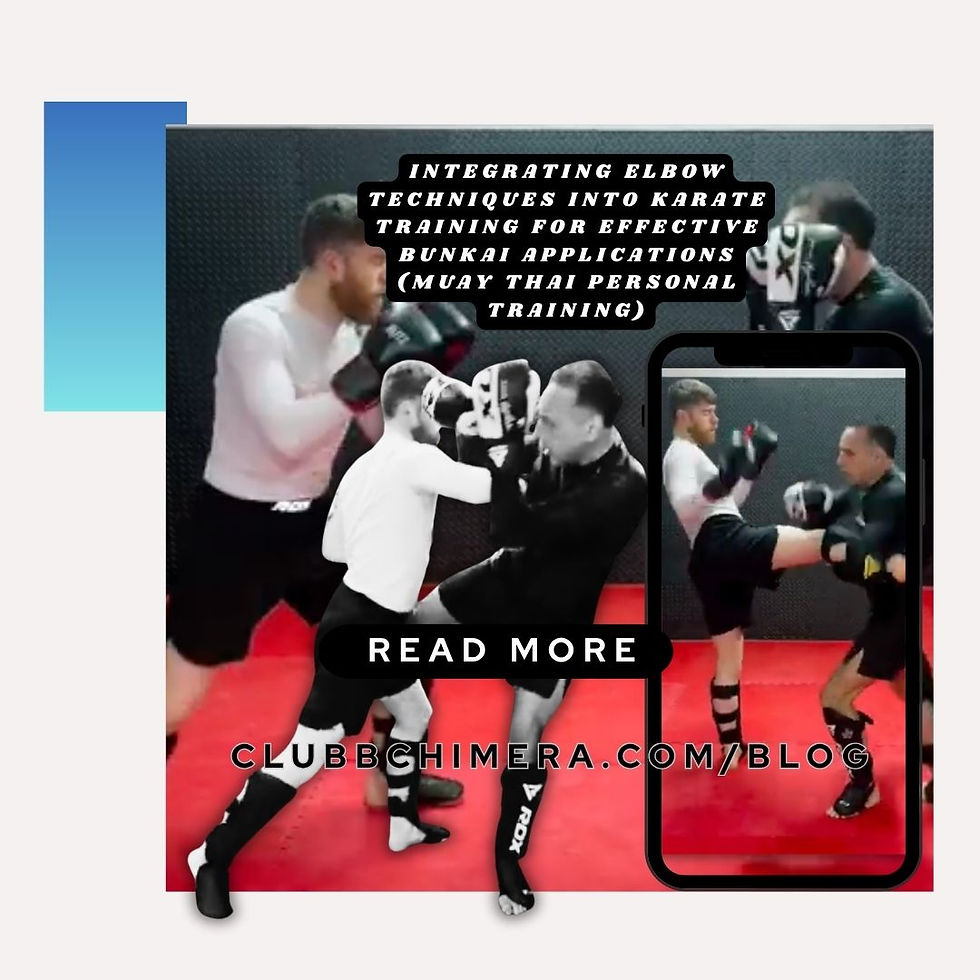
Over the last two blocks of 10 lessons, we narrowed the focus to elbow strikes. We covered the main elbow methods found in Muay Thai, then used mixed martial arts training ideas to test them against movement, clinch pressure, grips, and resistance.
Then we came back to karate.
More specifically, we came back to naihanchi.
Naihanchi is often treated as a strange kata because of its side-on movement and compact shape. In practical karate circles, it’s usually read as close-range fighting. That reading makes sense when you start looking at elbows, grips, posture breaks, and fighting from chest-to-chest or shoulder-to-shoulder positions.
That gave us the theme for the last part of the course: use a constraints-led approach to build sparring rounds that connect grip fighting, elbow entries, and kata-based habits.
What a constraints-led approach means in sparring
A constraints-led approach is a training method where you shape the rules of the round so that certain behaviours are more likely to appear.
That sounds more complex than it is.
Instead of saying, “Practise this exact elbow entry 20 times”, you change the sparring conditions so the student has to find the elbow entry under pressure. The rules create the problem. The fighter solves it.
This idea is common in modern coaching and comes from motor learning research. A well-known model from researcher Karl Newell describes skill as emerging from three kinds of constraints:
The person training
The task they’re trying to perform
The environment they’re performing in
In a martial arts class, that means skill doesn’t live in a neat drill by itself. It appears when a person with their own body, habits, fears, timing, and experience meets a live problem.
That’s why this format suits karate so well. Kata gives us shapes and principles. Sparring gives us pressure. Constraints give us a bridge between the two.
The trick is to make the rules narrow enough to guide the lesson, but open enough to let real timing appear.
Why elbows need more than pad work
Elbow strikes are not hard to understand. They’re short, sharp, and mechanically simple. A horizontal elbow, known in Thai as `sok tad`, is one of the clearest examples. The body rotates, the elbow travels across, and the person hits with a tight structure.
The hard part is not the elbow itself. The hard part is earning the position.
Elbows usually need one or more of these conditions:
Close range
A broken posture
A clear line past the opponent’s guard
A controlled limb or shoulder
A moment where the opponent is covered, trapped, or moving the wrong way
If someone stands at long range with a tidy guard, an elbow is not magic. It becomes a reach, a lunge, or a crash into someone’s forearms.
That’s why we linked elbow sparring to grip fighting. Grappling arts spend a lot of time teaching how to connect to another person, control their frame, disrupt their posture, and make space for attack. Karate has those ideas too, especially in kata, but many modern classes don’t practise them enough against resistance.
Cross-training with muay thai, wrestling, no gi jiu jitsu, gi wrestling and mixed martial arts (MMA) gives useful ways to pressure-test those old karate ideas, provided we bring the lessons back to the original karate context.
Why we used naihanchi as the karate anchor
Naihanchi is full of close-range habits.
The kata has a low, rooted stance. It uses tight arm movements. It turns the body through the hips. It often places one arm across the body while the other hand chambers, covers, checks, or prepares to strike.
Many interpretations of naihanchi include:
Gripping and checking arms
Elbow strikes
Shoulder bumps
Knee control and low-line disruption
Posture breaks
Fighting while crowded
That doesn’t mean every movement has one fixed application. Kata doesn’t work well as a codebook where one move always equals one technique. It works better as a compact training record of combative habits.
For this course, the habits we wanted were simple:
Get a useful grip
Deny the other person’s grip
Break posture without throwing
Clear the guard
Enter safely with the elbow
Hide the elbow behind other threats
Those habits shaped the sparring rounds.
The four sparring rounds we used
The rounds below were designed as a progression. Each one isolates a problem, then the next one adds a little more chaos.
This is not full fighting. It’s not point sparring either. It’s specific sparring, where the rule set forces both people to work on the same theme.
Round | Cross-training element | Main constraint | Goal |
1 | Non-jacketed wrestling and grappling | Only grips and grip defence, no takedowns | Establish and defend no-gi grips |
2 | Jacketed wrestling and grappling | Only clothing grips and grip defence, no takedowns | Use clothing grips to secure targets |
3 | Muay Thai elbow entries | Start in long guard, elbows only | Clear obstruction and land the elbow |
4 | Muay Thai striking with Motobu-inspired hiding | Punches set up elbows | Hide the elbow behind hand attacks |
Let’s go through them properly.
Round 1 teaches basic grip fighting without a jacket
The first round used non-jacketed wrestling ideas. Think Greco-Roman wrestling, catch wrestling, and other systems where people fight for control without relying on clothing.
The constraint was clear:
Only grips and grip defence were allowed. No takedowns. Breaking posture was encouraged.
That meant the round could include:
Wrist control
Biceps control
Triceps control
Collar ties
Underhooks
Overhooks
Shoulder posts
Pummelling for inside position
The goal was to establish and defend no-gi grips.
This round matters because elbow strikes need access. If someone can always frame on your chest, keep your head away, or pin your arm, your elbow options shrink. If you can win inside position, control a wrist, or fold their posture, your elbow options grow.
We also made posture breaking legal, but throws illegal. That small rule changed the feel of the round.
The student could pull the head down, twist the shoulders, or bump the body off line, but didn’t have to worry about being launched. That kept the round focused. It gave us realistic upper-body resistance without turning the lesson into a wrestling match.
For karate, this connects well to hikite, the pulling hand. Hikite is often explained as pulling the fist to the hip. In application, it’s more useful as a grabbing, clearing, pulling, and controlling action. Round 1 made that idea physical.
Round 2 uses clothing grips to set the target
The second round brought in jacketed grappling. Judo, Brazilian jiu jitsu, sambo, and Cornish wrestling all have rich grip-fighting traditions. The gi or jacket changes everything because clothing becomes a handle.
The constraint was:
Only clothing grips and their defence were allowed. No takedowns. Breaking posture was encouraged.
This allowed grips on:
Collar
Lapel area
Sleeves
Upper arms through the fabric
Shoulder line
Back of the jacket or training top
The goal was to establish and defend clothing grips that secure targets.
A collar grip can pull the head into range. A sleeve grip can pin one arm long enough to expose the side of the head. A grip behind the shoulder can turn the body and open the jawline. Even a simple two-on-one sleeve control can make an elbow line appear.
This is a useful reminder for karate people because traditional clothing was not skin-tight sportswear. Historical striking and grappling often assumed some kind of gripping surface. Modern self-protection situations may involve coats, hoodies, shirts, or bags. Clothing changes the range.
The round also showed what not to do. If the person gripping overcommitted, they became stiff. If they stared at the grip, they missed the opponent’s posture. If they pulled without moving their feet, they got dragged back.
That’s good training. A bad grip teaches as much as a good one when the round gives honest feedback.
Round 3 releases the elbow from long guard
The third round moved from grip-only work to elbows.
The starting position was specific:
Both fighters began in long guard, just touching gloves. No techniques were allowed except elbow strikes, preferably the horizontal elbow.
The long guard is a high, extended guard used a lot in Muay Thai. It manages distance, frames against the opponent, and gives a barrier against entries. For this round, it created the main problem: both people had arms in the way.
The goal was to clear obstruction or roll off obstruction to land the elbow, then defend and counter the same attack.
This produced several useful answers:
Parry the lead hand across and step in
Swim inside the frame and turn the elbow over
Roll the forearm over the opponent’s arm
Pull the guard down just enough to expose the line
Use head position to stop the counter
Exit after landing instead of admiring the work
Because only elbows were allowed, nobody could bail out with a jab, hook, knee, or kick. That forced the elbow problem to stay alive.
The danger with any isolated round is that people game it. They know what’s coming, so they defend in unnatural ways. That’s fine for a short round. It’s part of the learning stage. Later rounds need more options so the elbow has to be hidden again.
Round 4 hides the elbow behind the hands
The fourth round took inspiration from Choki Motobu’s idea of the “hidden hand”. Motobu was known for practical karate and close-range fighting, and his writings often point towards controlling one hand while striking with the other. The exact wording varies in translation, but the training idea is clear enough: the visible action can conceal the real strike.
The constraint was:
Straight punches and hooks had to be used to create the elbow. The elbow should arrive from behind the hand attack, not as a naked charge.
This changed the rhythm immediately.
Now the elbow could appear after:
A jab that draws a high guard
A cross that makes the opponent shell
A hook that folds into an elbow on the same line
A missed punch that turns into a spinning or returning elbow
A hand check that becomes an elbow entry
A punch that forces the opponent to cover one side, exposing the other
This round felt much closer to practical karate because it blended striking and control. The hands were not just punches. They were probes, covers, frames, and traps.
It also linked back to naihanchi. Many naihanchi motions make more sense when one hand is doing a visible job while the other hand is doing the damaging job. The kata’s compact arm positions can represent checking, clearing, and striking in tight spaces.
Round 4 also made defence more honest. If the defender only watched for elbows, punches landed. If they only blocked punches, elbows slipped through. That uncertainty is where useful sparring lives.
How to keep elbow sparring safe and useful
Elbows are high-risk tools. They cut, concuss, and damage at short range. That’s why the training rules matter.
For this block, the aim wasn’t to “win” rounds. The aim was to build timing, position, and decision-making.
Good safety controls include:
Use light contact to the head
Aim to touch, not smash
Use pads when needed
Keep rounds short
Stop when posture breaks become wild
Don’t allow blind spinning attacks in crowded space
Agree targets before the round starts
Increase resistance slowly
There’s also a coaching point here. If elbows are trained only on pads, people may become brave in a way that doesn’t survive contact. If elbows are trained too hard in sparring, people get injured and stop learning.
The middle ground is technical pressure. Enough resistance to expose mistakes. Not so much damage that the body starts protecting itself from the lesson.
What the recording showed
Recording the last two classes helped because video removes some of the guesswork.
In the moment, a student may feel as if they’re clearing the guard cleanly. On film, they might see their head is still on the centre line. They may feel as if they’re gripping with purpose. On film, they might see they’re holding fabric but not controlling posture.
The useful details were small:
The elbow landed more often when the feet moved first
Grips were stronger when posture was broken before the strike
Long guard entries worked better when the head moved off line
Clothing grips created clearer targets than bare-arm grips
Punches made elbows safer because they occupied the defender’s attention
That last point is key. Elbows are close-range weapons, but they don’t have to start close. They can be built from a punch, a grip, a cover, or a failed exchange.
That’s where kata study becomes alive. The kata gives a compact shape. The sparring round gives the question. The answer has to be earned.
The main lesson for karate training
The best part of this block was seeing the material return to karate without feeling forced.
Muay Thai gave us a mature elbow vocabulary. Wrestling gave us grip fighting and posture control. Specific sparring gave us live feedback. Naihanchi gave us a karate frame that tied the work together.
A karate teacher doesn’t need to turn karate into another art to benefit from cross-training. The better route is to borrow honest training methods, test them, and then bring the lessons back into karate’s own language.
For elbow strikes, that means less fantasy and more position.
Win a grip. Clear a frame. Break posture. Hide the entry. Move the feet. Touch lightly in training, but demand honest timing.
That’s how a kata movement stops being a shape in the air and starts becoming a decision made under pressure.

Comments