


Martial Arts Cross-Training Games for Mastering Horizontal Elbows and Hidden Hand Entries


Martial Arts Cross-Training
The eighth hour of a training course is a good time to test whether the work has become usable. Not polished. Not finished. Usable.
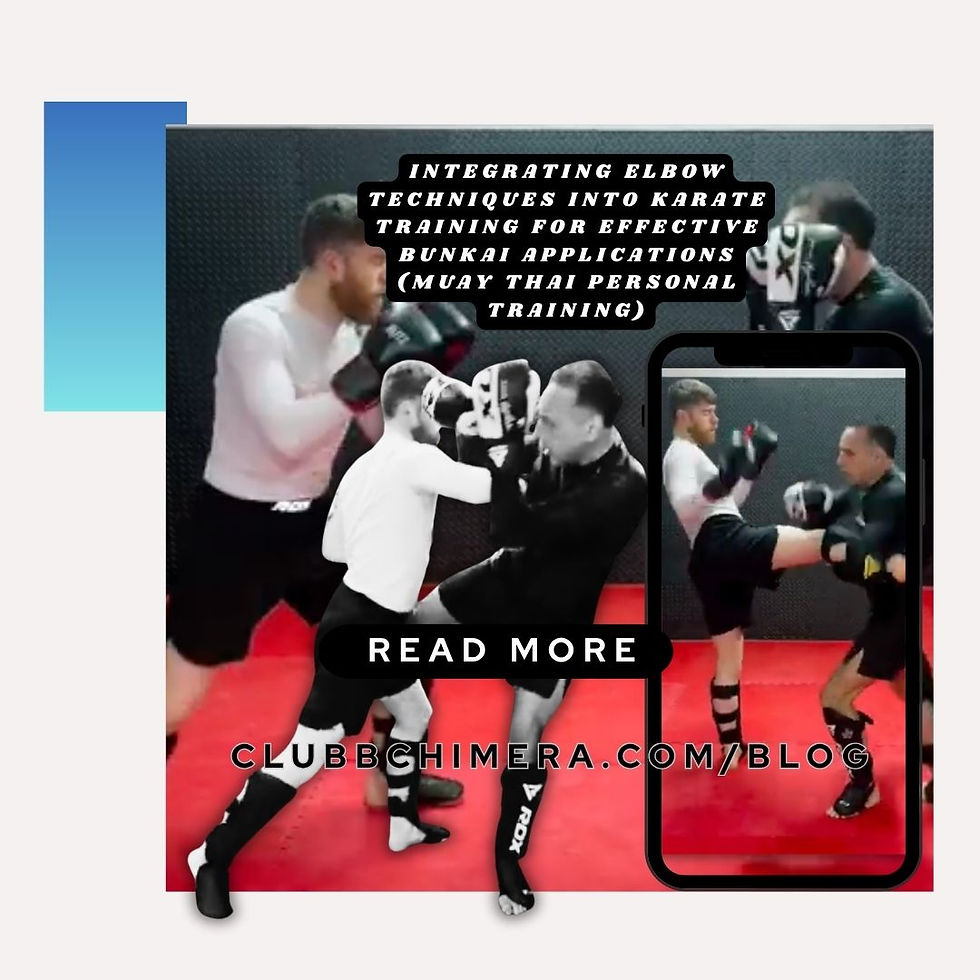
My client from Cotswold Karate School has been taking several months of Muay Thai cross-training lessons. The aim has not been to replace karate with kickboxing. The aim has been to use kickboxing and Muay Thai as attribute training, so certain ideas already present in karate can become more alive under pressure.
We have already worked on leg kicks and knee strikes. Elbows, though, have taken the most attention. This session became the point where those elbows had to stop being isolated techniques and start becoming part of a live sparring process.
The focus was the horizontal elbow, or `sok tad`, viewed through Naihanchi and supported by the kind of close-range entry associated with Motobu’s “hidden hand” idea. The core questions were simple:
How do you secure a target for the elbow?
How do you clear the obstruction between elbow and target?
How do you hide the elbow behind punches and grips?
How do you make it work without turning kata into choreography?

Cross-training should reveal what is already there
I am not a karateka. That matters because this session was not about me teaching karate. It was about using Martial Arts Cross-Training to identify universal principles, then borrowing training methods from other systems to develop those principles.
The kata gave us the map. Grappling and Muay Thai gave us pressure-testing tools.
Naihanchi contains close-range striking ideas that can be interpreted through grips, posture breaks, limb clearing and short power. A horizontal elbow rarely lands cleanly if both people are free to move, frame, cover and hand fight. It usually needs one of three things first:
A grip that holds the target in place
A limb clear that opens the line
A strike or feint that hides the entry
That is where the cross-training material becomes useful.
Grappling systems are built around the fight for grips and posture. No-gi wrestling, Greco-Roman wrestling, Catch-as-Catch-Can and similar systems all teach how to pummel, frame, control arms and break structure without relying on a jacket. Jacketed systems such as judo, Brazilian jiu-jitsu, sambo and Cornish wrestling add another layer, because the gi creates collar and sleeve grips that can anchor the head and shoulders.
Muay Thai adds the elbow mechanics. It also adds the long guard, the clinch, the habit of clearing frames, and the ability to strike from a compressed range. In this context, the relationship between Muay Thai and Karate was not a matter of style comparison. It was a practical way to bring a karate-shaped problem into a live striking framework.
The kata gave us the concept. The games gave us resistance.
The horizontal elbow needs a target before it needs power
A common mistake with elbow training is to start with the finish. The striker practises the elbow in the air, on pads, or against a compliant partner who leaves a perfect gap. That has value, but it misses the hardest part.
The hardest part is not swinging the elbow. The hardest part is getting close enough, clearing the path, and keeping the other person from ruining the strike.
A horizontal elbow needs the opponent’s head or jawline to be available. In a resistant exchange, that availability must be created. That usually means taking control of the head, collar, arm or shoulder line.
In this lesson, we treated the elbow as the result of a short chain:
Win or deny the grip.
Break or protect posture.
Clear the obstruction.
Strike on the opened line.
Recover position or follow with control.
This is why the first games were not striking games. They were grip-fighting games. If the student cannot win the hand position or defend against grips, the elbow will remain a theoretical technique.
The elbow is a close-range weapon, but close range has to be earned.
From a karate perspective, this makes kata-based sparring more honest. The movement is no longer a shape copied from a form. It becomes a decision made under pressure.
The six cross-training games build from grip to kata-based sparring
The games below were designed as a progression. Each round isolates one attribute, then brings it closer to the final goal. The constraints are not there to make the training artificial. They are there to stop the session becoming generic sparring too soon.
When the rules are tight, the lesson becomes clear.
Round | Cross-training element | Constraint | Goal |
1 | No-gi wrestling and grappling | Only grips and grip defence are permitted. No takedowns. Breaking posture is encouraged. | Establish and defend no-gi grips. |
2 | Jacketed wrestling and grappling | Only clothing grips and grip defence are permitted. No takedowns. Breaking posture is encouraged. | Secure collar and sleeve controls to create targets. |
3 | Muay Thai and related Southeast Asian striking arts | Both fighters begin in long guard with gloves touching. Only elbow strikes are permitted, preferably horizontal elbows. | Clear obstruction, roll off frames, land elbows and defend counters. |
4 | Muay Thai striking entries inspired by Motobu’s hidden hand | Straight punches and hooks must set up the elbow. Every combination must end with an elbow. | Hide the elbow behind punches, especially hooks. |
5 | Karate with Muay Thai and wrestling attributes | Gripping and elbow strikes only. Clothing grips are allowed if training in gi. | Blend grip fighting with elbow entries in a karate context. |
6 | Karate and gi-MMA style pressure | Gripping and elbow strikes only, with more live movement and less predictable starts. | Build towards kata-based sparring with resisting partners. |

Comments